Albin de la Simone
Amiens — Chanson · Piano-illustration
Twenty years of intimate songwriting built on restraint: piano, near-spoken voice, ordinary subjects handled without pathos. An arranger turned author — after a decade invisible behind Vanessa Paradis, Henri Salvador, Jeanne Cherhal — who draws his own sleeve art and shapes sound and image by the same precise gesture.
Why restraint is a technique
His music does not rise at the right moment. There is no orchestral climax on the painful word, no modulation when the text turns grave. This is a choice — not an absence.
Albin de la Simone came to songwriting through the wings. Ten years arranging for others — Vanessa Paradis, Henri Salvador, Jeanne Cherhal — taught him to hear what not to put in a song. This negative lesson is the foundation of his entire body of work. When he moves to the solo format in 2003, he carries this mastery of economy with him.
He is also an illustrator. He draws his own sleeve art, publishes books with Actes Sud. This is not a hobby alongside the music: it is the same practice in two forms. In a line drawing, each line serves a function — nothing is there for decoration. In his songs, each note serves a function. The piano-as-illustration is not a metaphor: it is a precise description of the method.
The five albums that follow — from Albin de la Simone (2003) to Happy End (2021) — show how these two constants cross different contexts (label changes, arranging interludes, pandemic) without ever bending. What does not move is the method.
Among the singer-songwriters of his generation in the French song of the 2000s, Florent Marchet shares this same economy of means — piano-voice as primary device, observation of the everyday without romanticisation, refusal of emphasis. Two parallel trajectories, two distinct approaches to the same territory.


◆ Musicological studies
The work’s tracks examined closely — device, structure, procedure, lineage, reading under the permanences.
Albin de la Simone
The voice found. A piano, a few notes, nothing more than needed.
After a decade as an invisible arranger — Vanessa Paradis, Henri Salvador, Jeanne Cherhal, Alain Souchon — Albin de la Simone releases his first solo album at thirty-three. Without an obvious label, without heavyweight management, without an apparent career plan.
The approach
Upright piano, voice close to the microphone, short songs. No layered arrangements, no programmed drums, no stacked keyboards. The setup is deliberately spare — not from budgetary constraint, but because a man who spent ten years building sound architectures for others knows exactly what not to put in.
The result is immediately recognisable: a voice that narrates rather than sings, a piano that comments without illustrating. Restraint is not timidity — it is the technique by which emotion circulates without being pre-digested.
”A debut of rare restraint and precision in French song.”— Télérama
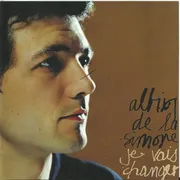
Je vais changer
The deferred promise. Change, always tomorrow.
Two years after the debut, Albin de la Simone returns with a title-programme that says everything about his method. Je vais changer — I’m going to change — is a declaration of intent always deferred, a promise that turns on itself and becomes the subject. This is not easy self-deprecation: it is the exact observation of a human mechanism.
The approach
Slightly more orchestrated than the first album — a few strings, discreet, that do not underline but accompany from a distance. He does not break with minimalism; he loosens it. The piano remains central, the voice remains close, the arrangements remain in service of the text.
The song structures are still short and efficient. No instrumental bridge to “build” emotion, no modulation to “add sweep”. The architecture is that of a line drawing: each element serves a function, nothing is decorative.
”Albin de la Simone confirms a singular voice in French song: that of an observer without cynicism.”— Les Inrocks
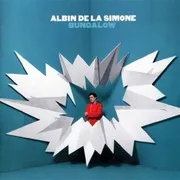
Bungalow !
The turning point. The piano-voice grammar carried to its definitive balance.
Third album. The one critics most often cite as his masterpiece. The title evokes both a modest house and a life’s parenthesis — the domestic space as his chosen territory. Not a villa, not a loft: a bungalow. The place where people actually live.
The approach
The piano is more present than ever — not louder, but more assured in its role. The songs are built around ostinatos, repetitions that dig without advancing. The spoken-sung voice reaches its optimal balance: neither fully spoken (too distanced) nor fully sung (too emphatic). Something between the two, letting the text breathe.
Adèle is the best-known song: a nursery-rhyme portrait of an ordinary woman, three verses with no chorus, no dramatic rise. It is not a love song in the sentimental sense — it is a portrait. Discretion as material at its purest.
”With Bungalow!, Albin de la Simone delivers one of the most singular albums of the decade.”— Libération
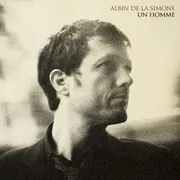
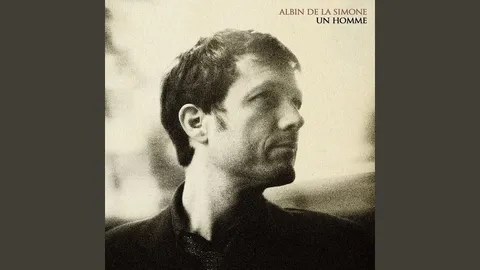
Un homme
Maturity. Fewer arrangements, more presence.
Five years separate Bungalow ! from Un homme. In the interval: arrangements for Pomme, Pierre Lapointe, Emilíana Torrini — again this position of the invisible craftsman, nourishing without showing himself. When he returns with an album, something has shifted. The title-programme says it plainly: un homme. A man. Not a character, not a narrator — him.
The approach
The stripping-back is radical. Fewer instruments than on Bungalow !, more space in the sound. The voice sits further forward. The album resembles a charcoal portrait after years of painting — same subject, medium reduced to its essence.
The duet with Emilíana Torrini (Moi moi) is the album’s exception — two voices approaching without merging, like two draughtsmen working on the same sheet of paper. The rest is solo.
”Un homme: the most accomplished album in a decade of coherent work.”— Télérama
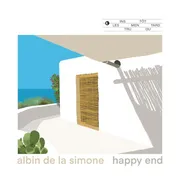
Happy End
Gentle irony. A happy end that promises nothing.
After L’un de nous (2017) — a more choral album, collective format — Albin de la Simone returns in 2021 to the intimate form. Happy End: the title is ironic, or resigned, or both simultaneously. As often with him, the title-programme contains the whole method. A happy end is what one hopes for. Not necessarily what one obtains. The distance between the two is where he works.
The approach
Album recorded before the pandemic, released during it. This temporal displacement gives it a slight additional tinge of melancholy — without that being premeditated. Piano, voice, a few very discreet electronic pads. Slightly darker in tone than previous albums, without ever tipping into emphatic gloom.
The gesture is the same as in 2003, eighteen years earlier. This is not stagnation: it is proof that a found voice remains true over time.
”An artist who has built something rare: a coherence that sounds like no one else.”— Les Inrocks
A body of work in four movements
Seen from a distance, the trajectory is clear. No spectacular breaks, no 90-degree pivots. A voice found in 2003 and held since, through changing contexts, different labels, a dual practice as musician and illustrator always active.
What never changes
Two constants cross all four movements: discretion as material and the piano-as-illustration. These two gestures are the true signature. They are not the result of a constraint — financial, technical or otherwise — but of a deliberate aesthetic choice, formed during the years of arranging for others and maintained since.
The close analyses of Le Grand Amour (Bungalow !, 2008) and Un homme (2013) show how these two constants manifest in the detail: the piano ostinato functioning as a graphic motif, the near-spoken voice leaving space for the listener, the systematic refusal of musical underlining.
Cross-artist bridge
In the landscape of French song in the 2000s, Florent Marchet shares with Albin de la Simone the same economy of means: piano-voice as the primary device, observation of ordinary everyday life, refusal of emphatic lyricism. Two singer-songwriters of the same generation, two distinct ways of inhabiting the same territory — the intimate without romanticisation. Marchet towards the pavilion suburbs and their geographies; Albin de la Simone towards human relationships in their ordinary duration.
The map
Albums orbiting the two constants. Click an album to see how it expresses them.
Piano-as-illustration: piano alone, radical economy of arrangements — the arranger knows what not to put in.
Position: starting point. The voice is found.
Piano-as-illustration: a few strings added, light as hatching in a drawing.
Position: confirmation. The frame holds.
Piano-as-illustration: ostinato of Le Grand Amour = graphic motif of duration.
Position: masterpiece. The piano-voice grammar at its definitive balance.
Piano-as-illustration: radical stripping-back — the silences are part of the structure.
Position: maturity. The 2003 gesture carried to its limit.
Piano-as-illustration: same economy of means as in 2003, eighteen years later. The line cleaner still.
Position: persistence. Coherence as a response to time.