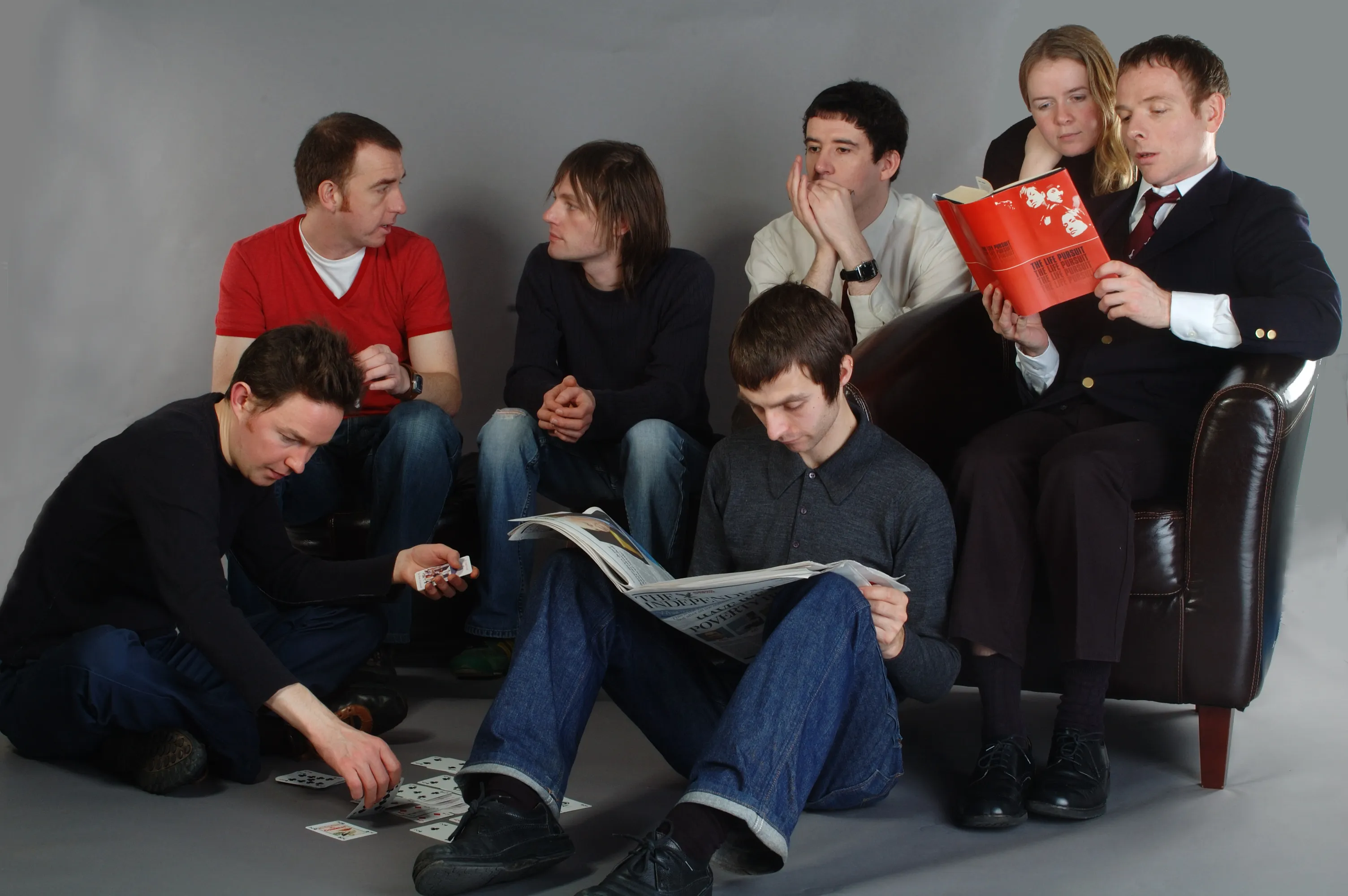
Belle and Sebastian
Glasgow — Indie chamber-pop
Twenty-five years, eleven albums, six members, one city: Glasgow. Stuart Murdoch and Belle and Sebastian have maintained two permanent gestures since 1996: telling peripheral lives with a short-story writer's precision — the pharmacist, the failed athlete, the girl at the bus stop — and refusing the grand gesture — chamber arrangements (strings, flute, trumpet) that never underline the emotion of the text. Discretion as form.
Why a pop song doesn't need to raise its voice
Stuart Murdoch never needed to shout. The Belle and Sebastian pop song murmurs, observes, notes the details that change everything — the flute that passes without insisting, the third-tier character who becomes the subject. It is a pop song that tells the stories of people that other songs forget.
Formed in Glasgow in 1996 as part of a music class at the Glasgow School of Art, Belle and Sebastian released two albums in a single year — Tigermilk (1,000 vinyl copies), If You’re Feeling Sinister — and invented a register: indie chamber-pop. Not the muscular britpop of Oasis, not the electronica of the Chemical Brothers. Acoustic instruments treated with chamber-music care, texts that place precise characters in two details, a voice that does not seek to convince but to narrate. Twenty-five years, eleven albums, six members — and two permanences that never move.
The six albums that follow show how these two permanences hold through radical turns: from the university room (Tigermilk) to Trevor Horn’s production (Dear Catastrophe Waitress), from Tony Hoffer’s glam (The Life Pursuit) to the stripped-back return (Late Developers). The signature resists everything.
A bridge crosses the Channel: Florent Marchet shares with B&S the same refusal of the grand gesture and the same attention to peripheral lives — the chamber arrangements of Rio Baril and Garden Party on the French side, If You’re Feeling Sinister and Arab Strap on the Scottish side. Two contemporary projects, two languages, the same aesthetic posture.


◆ Musicological studies
The work’s tracks examined closely — device, structure, procedure, lineage, reading under the permanences.
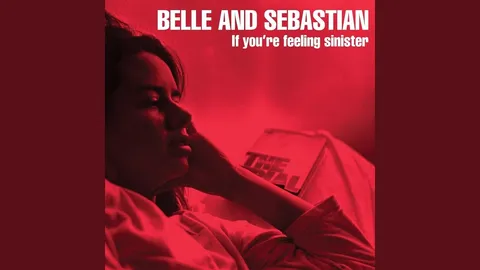


Tigermilk
The accidental album. A thousand vinyl copies for a music class. All of B&S is already here.
Tigermilk was never meant to exist as a commercial object. Belle and Sebastian recorded it in 1996 as part of a music class at the Glasgow School of Art — an enterprise module where students had to run a project from start to finish. Stuart Murdoch wrote all ten tracks, the group recorded in a few weeks, and the record was pressed in 1,000 vinyl copies under the house label Electric Honey. The group refused photos, refused interviews. The scarcity was accidental, then cultivated.
The device
Sober production, university budget. Acoustic guitar, piano, sparse strings, flute — chamber arrangements in seed form. Stuart Murdoch sings almost in a whisper, as if telling a story in your ear. Ten tracks, thirty-five minutes. All of B&S’s vocabulary is set here: precise secondary characters rather than a universal “I,” stories of Glaswegian students escaping through books or dreams, a faded instrumentation that never underlines the emotion of the text.
The State I Am In is the programme piece: a character in flight, an oblique confession, a flute that passes without insisting. The entire subsequent body of work is already contained in these three minutes.

If You're Feeling Sinister
Absolute masterpiece. Murdoch at the peak of character writing. Released six months after the first.
Six months after Tigermilk. Same Glasgow, same peripheral characters, same chamber discretion — but Stuart Murdoch’s writing has gained precision and confidence. If You’re Feeling Sinister is ranked among the best indie albums of the 1990s by Pitchfork (10/10, Classic). Eleven tracks, forty minutes, not a weak moment.
The device
The album works like a gallery of short stories — each track places a character in two or three details and lets them exist. The athlete who wastes his life (The Stars of Track and Field), the cinephile who prefers film glamour to reality (Like Dylan in the Movies), the ephemeral insect with its few hours of life (Mayfly), the girl who escapes a party by reading (Get Me Away from Here, I’m Dying). Murdoch doesn’t judge his characters — he observes them with a mildly ironic benevolence.
The instrumentation is the same chamber vocabulary as Tigermilk — acoustic guitar, piano, discreet strings, flute — but the sound is more assured, the arrangements slightly richer. The entire album holds within a muffled dynamic: the voice is never raised, and that is precisely what captivates.

The Boy with the Arab Strap
The most collective. The most danceable. The gallery widens — other members sing their own characters.
Third album, two years after the two 1996 releases. Belle and Sebastian is no longer solely Stuart Murdoch’s vehicle: for the first time, Stevie Jackson sings his own tracks (A Summer Wasting, Is It Wicked Not to Care?). The group exists as a collective, not just as a framework for one author. The gallery of characters widens — other voices, other viewpoints.
The device
The sound broadens without swelling. The title track is the most danceable in the B&S catalogue — a quasi-chamber disco, groove asserted but dynamics still contained. Sleep the Clock Around is the most formally ambitious song: seven minutes that unfold without forcing. Dirty Dream Number Two is pop-rock without being mainstream. The group explores its limits while maintaining both permanences.
This is the peak of the Jeepster years — the founding trilogy (Tigermilk, Sinister, Arab Strap) lays down B&S’s entire vocabulary. After this album, the group will search for how to grow without betraying itself.

Dear Catastrophe Waitress
Trevor Horn produces. The pop opening without betrayal. A successful transition.
A return after Fold Your Hands Child, You Walk Like a Peasant (2000, too introverted) and the Storytelling soundtrack (2002). Belle and Sebastian makes a radical decision: working with Trevor Horn — producer of Yes, ABC, Frankie Goes to Hollywood, ZTT Records. A grand-format producer for a chamber group. The result is not the erasure of B&S’s vocabulary by pop production — it is an unexpected synthesis.
The device
The production is brighter, wider, more radio-friendly than anything B&S had done before. I’m a Cuckoo is the first single that genuinely makes it onto radio. Step into My Office, Baby is pure 60s pop momentum. And yet: Murdoch still writes precise characters — the catastrophic waitress of the title, Roy Walker trying to seduce, the girl you want to stay. The chamber vocabulary is stretched, not erased.
The album opens B&S to a new audience without conceding on the writing. That is the definition of a successful transition: change the production, keep the soul.
The Life Pursuit
Power-pop and glam turn. Los Angeles. Tony Hoffer. Assumed pop, Murdoch's texts intact.
Recorded in Los Angeles with Tony Hoffer — producer of Beck, Daft Punk, M83. Belle and Sebastian makes its The Life Pursuit the way Beck makes records: change the sound, keep the soul. The result is the most immediately accessible album in the catalogue — power-pop, 70s glam, light disco — yet Murdoch has not altered a single word of his character writing.
The device
The sound is brighter, more saturated, more rock than anything B&S had done before. White Collar Boy is quasi-disco with an assertive guitar riff. Funny Little Frog is the perfect 3-minute single — an unforgettable melody, a discreetly brassy chorus. Sukie in the Graveyard borrows from 70s pop (T. Rex, Bolan). The group seems to be enjoying itself — a communicative pleasure.
And yet the texts are the same: a white-collar worker observing his own life from a slight distance (White Collar Boy), a girl in a cemetery who lingers as if the dead had something to teach her (Sukie), an endearing and slightly ridiculous frog (Funny Little Frog). Murdoch makes glam with characters from realistic fiction.

Late Developers
Serene maturity. Murdoch observes his own life with the same distance as his characters. Return to the core.
Twenty-seven years after Tigermilk, Belle and Sebastian delivers one of its most confident albums. After the electro-disco experimentation of Girls in Peacetime Want to Dance (2015) and the return to essentials on A Bit of Previous (2022), Late Developers confirms a direction: at fifty, the group has found the same clarity of writing that Murdoch had at twenty-five — but without the feverish urgency of the early years. Serenity as form.
The device
The sound is clean without being cold; the chamber arrangements have returned without nostalgic pretence. Murdoch writes with precise lightness: I Don’t Know What You See in Me is a love song that questions its own legitimacy without wallowing. Unnecessary Drama observes a mundane situation with characteristic dry wit. The group has been playing together for twenty-five years — you can hear it in the way the arrangements breathe.
The album’s title is a kind of collective self-portrait: people who took time to flourish, who are not in a hurry, who still make records in serenity. Late developers — those who arrive late to their own blossoming. Murdoch now observes his own trajectory with the same mildly ironic benevolence he has always brought to his characters.
A body of work in four movements
Viewed from a distance, Belle and Sebastian’s discography reads as a series of courageous decisions and stubborn resistance. Four movements, two permanences, a single artistic project that changes costume without changing soul.
What never changes
Two permanences run through all four movements: peripheral lives as narrative matter — Murdoch is never the hero of his own songs, he observes with a mildly ironic benevolence — and chamber arrangement as refusal of the grand gesture — the music never underlines the emotion of the text, even in glam (The Life Pursuit) or electro-disco (Girls in Peacetime). These two gestures are the true signature. Everything else — chamber, pop, glam, electro — is material.
The bridge — observation and discretion
The close readings of Get Me Away from Here, I’m Dying and The Boy with the Arab Strap reveal the same paradox found in Florent Marchet: the text recounts ordinary lives with precision, the music refuses to dramatise them. This is the inverse of mainstream pop, where the arrangement amplifies the emotion of the text. Murdoch and Marchet make the same counter-bet — not the same medium, not the same language, but the same aesthetic of the un-sublimated everyday. Observation without grandiloquence as form.
The map
Six albums orbiting the two permanences. Click an album to see how it deploys them.
Chamber: recorded with university means — the constraint becomes a signature. The muted sound is there from the very beginning.
Position: matrix. 1,000 vinyl copies. All of B&S is already contained here.
Chamber: flute in counter-melody, discreet piano, muted dynamic. The album never raises its voice.
Position: absolute masterpiece. 10/10 Pitchfork Classic.
Chamber: the grooviest — and yet the volume never rises. The permanence holds against the danceable impulse.
Position: peak of the Jeepster years. B&S as group, not solo.
Chamber: Trevor Horn production brighter but neither thunderous nor flashy. Brilliance is not excess.
Position: successful transition. First radio hit. B&S learns to speak to everyone.
Chamber: the most rock in the catalogue — and yet: no saturation, no shouting. Tony Hoffer doesn't break the signature.
Position: assumed pop ambition. Los Angeles. Glam turn succeeded.
Chamber: return to stripped-back sound, clean without being cold. The founding gesture of 1996 returned, lightened by experience.
Position: serene maturity. 27 years after Tigermilk. B&S has nothing left to prove.