IAM
Marseille — French Rap · Egyptology
Thirty-five years, nine studio albums, six founding members, one city: Marseille. Akhenaton, Shurik'n, Imhotep, Khéops, Kephren, Freeman have set two permanent gestures since 1989: Marseille at the centre, the world at the periphery — inverting the province/capital relationship, the Phocaean city as Mediterranean crossroads, rap as geography from the South. And Egyptology as political metaphor — pharaonic pseudonyms, Memphis as Marseille's secret name, Africa as origin, refusal of the purely Gallic genealogy of French rap.
Why Marseille is the world
In 1991, French rap is Parisian or a copy of American. IAM does something else: it places Marseille at the centre of the world. Not as a regionalist posture, but as an aesthetic and political programme. Akhenaton, Shurik’n, Imhotep, Khéops — the pharaonic pseudonyms are not stage names. They are a genealogy. Egyptian civilisation is African before it is Arab or European. Memphis is Marseille’s secret name. French rap has a Mediterranean root it had forgotten: IAM reclaims it.
Thirty-five years later, this inaugural gesture has not aged. L’École du micro d’argent (1997) remains certified diamond — the best-selling French rap record. Demain c’est loin is ranked #1 in the genre’s classics by Abcdr du Son. In 2019, Yasuke transposes Egyptology into Japanology, finding in the 16th-century Black samurai an alter ego for the Mediterranean exile. The framework inaugurated in 1991 is solid enough to absorb three decades.
The five pivot albums structuring this cartography unroll the arc: De la planète Mars (1991, the manifesto), Ombre est lumière (1993, commercial validation), L’École du micro d’argent (1997, the masterwork), Revoir un printemps (2003, the return), Yasuke (2019, total concept). Between the third and fourth, six years of individual solo projects — a structural decompression, not a rupture.
In the cartographies collection, the bridge with Orelsan is the most solid. Orelsan cited IAM in the Amazon documentary Montre jamais ça à personne (2021) as a founding reference. Both map France from their respective city (Marseille for IAM, Caen for Orelsan), same register of everyday observation, same refusal of direct moralising. IAM is the elder — baroque-literary, collective, Mediterranean; Orelsan is dry-conversational, solo, Norman. Same ethics of attention, different mediums.


◆ Musicological studies
The work’s tracks examined closely — device, structure, procedure, lineage, reading under the permanences.

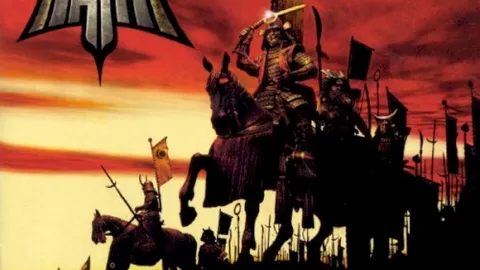
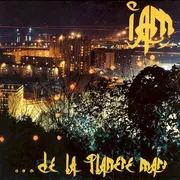
De la planète Mars
The founding manifesto. Mars as Marseille. Rap from the South, before Paris.
First album. Released 25 March 1991, the group formed two years earlier in the northern districts of Marseille. The title plays on verlan (French back-slang): Mars for Marseille, but also the red planet — deliberate distance from Paris, the chosen elsewhere. In 1991, French rap is still largely Parisian or perceived as an American copy. IAM immediately stakes out a third path.
The framework
Akhenaton, Shurik’n, Imhotep, Khéops — the core is already here. The pharaonic pseudonyms are set as an aesthetic programme: Akhenaton, the heretical pharaoh who imposed monotheism on Egypt in the 14th century BCE; Imhotep, architect and scholar of the third millennium; Khéops, builder of the Great Pyramid. These are not decorative stage names — they are an alternative genealogy. African civilisation as root. Memphis as Marseille’s secret name.
The first album’s sound: dense beats, heavy bass, a few oriental synthesisers pointing toward the direction ahead. Imhotep’s production is still developing — it will be refined on Ombre est lumière. But the proposition is clear: French rap from the South, with its own references.
”Here it’s Mars / That’s where we leave from / To land somewhere / Where life will have another meaning”— IAM, Planète Mars, 1991
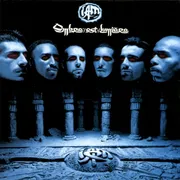
Ombre est lumière
The double album of maturity. The unlikely hit, the political depth. IAM commercially validates the Marseille proposition.
Second album, a double — two discs, two ambitions. Released 2 November 1993, produced by IAM and Nick Sansano. The title states the duality: shadow and light, the dark side of life in the projects and the bright side of a rising collective. Two faces of the same Marseille.
The framework
The double structure allows IAM to explore both registers that will define their singularity. One side more accessible, aimed at the single and the radio — that is where Je danse le Mia lives. One side darker and political — life in the projects, racism, systemic violence, Mediterranean immigration. The collective refuses to choose between the hit and the depth. It does both.
Je danse le Mia becomes the #1 single in France at the start of 1994 — one of the most unlikely hits of the decade. Marseille suburban rap, in un-neutralised French, with accents and references to 1970s–80s Marseille, reaches the top of the national chart for eight non-consecutive weeks, alternating with Bruce Springsteen. The video is directed by Michel Gondry, before his American period. The principal sample: George Benson (Give Me the Night), Tom Browne (Let’s Dance), Fat Larry’s Band (Act Like You Know). The album is produced by IAM with Nick Sansano, engineer known for his work with Public Enemy.
”I come from the land where they dance the mia / An old dance that was born in the streets”— IAM, Je danse le Mia, 1994
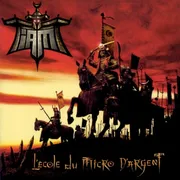
L'École du micro d'argent
The absolute masterwork. Diamond. Demain c'est loin, Petit frère, L'Empire du côté obscur — the summit of French rap.
Third album. Released 18 March 1997. Certified gold on release day, diamond since — the best-selling French rap record, with over a million equivalent sales. Recorded partly in the United States, with contacts in the Wu-Tang Clan network (RZA brings an aesthetic influence, not a direct collaboration). Produced principally by Imhotep with Khéops and Shurik’n.
The framework
The album carries a programme in its title: the School of the Silver Microphone — teaching through the mic, silver not as precious metal but as sonic quality (the silver microphone: the perfect microphone, the voice worked like silver). Seventeen tracks, no filler, each earns its place. Imhotep’s production reaches its peak: hard, organic beats, cinematic samples (American film noir, African music), oriental tones that anchor the sound in the Mediterranean without folklorising it.
Demain c’est loin — nine minutes, two verses (Akhenaton, then Shurik’n), no chorus. Sample of Stevie Wonder (Pastime Paradise) and Miriam Takeda. Ranked #1 in French rap classics by Abcdr du Son. Petit frère — a letter to a brother sliding into delinquency, among the most humane tracks in the catalogue. L’Empire du côté obscur — a critique of the excesses of American rap by people who know it from the inside.
”You remember when we used to play / We had nothing but we had everything / Time has flowed like sand”— Shurik’n, Demain c’est loin, 1997
Les solos — the collective's decompression (1995–2002)
Between L’École du micro d’argent (March 1997) and Revoir un printemps (March 2003), six years with no collective IAM album. Yet every member releases at least one solo record — the whole forming a corpus of structural decompression that prepares the return. This is not a rupture. It is breathing.
Akhenaton — Métèque et mat (1995) — first step outside the collective, released two years before the diamond of L’École du micro d’argent. The album explores territory closer to East Coast American rap, cinematic samples, harder voice. Akhenaton tests his singularity outside IAM. The result: he returns more certain of what the collective provides that he cannot do alone.
Shurik’n — Où je vis (1998) — the most literary of the solo records. Explicit French poetic references (Aragon, Moustaki), intimate rap, more muted sonic textures. Shurik’n confirms what IAM has sensed from the start: French rap is not incompatible with the French literary tradition. This conviction will inform the lyrics of Revoir un printemps.
Khéops — L’Odyssée suit son cours (1998) — a DJ album, instrumental explorations, beats and compositions with little or no vocals. Khéops demonstrates that IAM’s production has an identity independent of its voices. This productive dimension will remain: Imhotep and Khéops will continue to be the group’s sonic backbone.
Freeman — L’Œil du cyclone (2001) — engaged rap, Algerian identity themes, colonial memory, systemic racism. Freeman, of Algerian origin, explores what the IAM collective does not allow him to say at the centre — more directly political texts on the question of North Africa in France. The least known of the solo corpus, politically the most frontal.
Akhenaton — Sol Invictus (2001) — the most accomplished solo. Refined production, Latin and Mediterranean samples, voice at its finest. The title (Sol Invictus: the unconquered sun, the solar cult adopted by emperors in late antiquity) confirms the continuity of the historico-political metaphor. Black album (Akhenaton, 2002) closes the parenthesis.
The structural effect is threefold. (1) Each member returns enriched — new references, refined techniques, a confidence that only the collective can now carry. (2) The IAM catalogue fills laterally — the solos are often release valves for texts or directions the group decides not to take collectively. (3) The audience waits — for six years, IAM maintains media presence via the solos, without diluting the IAM brand itself. When Revoir un printemps comes out in March 2003, it comes out toward a loyal audience, not into a void.

Revoir un printemps
The return. Six years of solo projects, then IAM comes back as a collective. Spring as a metaphor for beginning again.
Fourth album. Released 24 March 2003 — seven days after Akhenaton’s solo record Le Chant des sirènes (17 March 2003). The proximity of the two release dates is deliberate: Akhenaton closes his solo chapter, IAM reopens the collective chapter. The group has let six years pass since L’École du micro d’argent. Each member has explored their own territory (see interlude: Les solos). Spring: the return after winter, rebirth.
The framework
The album is more settled, more contemplative than its predecessors. The voices have aged — Akhenaton and Shurik’n are thirty-five, no longer twenty-five. The fire of the first album and the power of the third give way to considered maturity. Themes: the return to Marseille, the duration of the collective, loyalty to origins, memory. Imhotep’s production remains, more orchestrated.
The return as a collective after the solos is an internal political act: a demonstration that the group is greater than any of its parts. IAM existed before the solos, IAM continues after. The collective is the frame.
”We return in spring / When time becomes again / What it was before / When we didn’t think about it”— IAM, Revoir un printemps, 2003
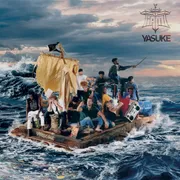
Yasuke
The concept album. The 16th-century Black samurai as mirror of the Mediterranean exile. Egyptology becomes Japanology.
Ninth studio album. Released 22 November 2019. Creative process: group retreat in Marrakech in early 2019, then recording in Bangkok (Thailand), mixed in New York at Germano studio. The most elaborate framework of the career — a concept album built around a real historical figure: Yasuke, an African slave who arrived in Japan in 1579 and became a samurai in the service of the warlord Oda Nobunaga.
The framework
The cover directly quotes Géricault’s The Raft of the Medusa (1818–19) — castaways at sea, intertwined bodies, despair and resistance. The link is explicit: Yasuke, the African exile en route to a foreign world, mirrors the migrants crossing the Mediterranean today. The album is also inspired by a real news event: a 14-year-old Malian migrant found drowned in the Mediterranean with his school report card sewn into his jacket.
Musically, the album integrates Japanese melodies and sounds — notably Omotesando (a Tokyo neighbourhood), the track Yasuké, arrangements evoking traditional Japanese music. Shurik’n, passionate about the Far East, introduced the group to these references. Imhotep’s production integrates them without cheap exoticism — the Japanese sonorities serve the concept, not the effect.
”He came from far away / As we come from far away / He crossed the seas / To find his destiny”— IAM, Yasuké, 2019
A body of work in four movements
Thirty-five years, nine studio albums, six founding members, one city. IAM’s trajectory divides into four distinct movements — each testing a different dimension of the double founding thesis: Marseille at the centre, Egyptology as political metaphor.
What never changes
Two permanences run through the four movements without faltering. Marseille at the centre, the world at the periphery — from De la planète Mars, which places Marseille as a world unto itself, to Yasuke, which looks toward Japan from the Phocaean port, passing through Je danse le Mia (70s Marseille at #1 nationally) and the return of Revoir un printemps, IAM never yields on geographic anchoring. The province is not a handicap — it is a position. Egyptology as political metaphor — the pharaonic pseudonyms inaugurate in 1989 a structure that is never abandoned. In 2019, this structure shifts toward Japanology (Yasuke the Black samurai), but the gesture is homologous: an ancient, noble civilisation as mirror of the immigrant Marseillais identity. Scribes in 1997, samurai in 2019 — same posture.
The bridge that holds
One solid bridge in the collection: Orelsan. A direct, documented filiation. Orelsan cites IAM in the Amazon documentary Montre jamais ça à personne (2021) as a founding reference. Both are narrators of France from their city — Marseille for IAM, Caen for Orelsan. Same refusal of direct moralising, same method of attention to the everyday. Not the same rap: IAM is baroque-literary, collective, Mediterranean; Orelsan is dry-conversational, solo, Norman. But the same ethics of observation. IAM is the elder who proved that observational rap from the provinces was possible. Orelsan is the younger who repeated the gesture, elsewhere, differently.
The work continues. In 2025, IAM still tours. Thirty-five years of continuity is rare in French rap — almost unique at this scale. The framework set in 1989 (Marseille as centre, Egyptology as political language) is solid enough to absorb more still.
The map
Five records in orbit around the two permanences. Click an album to see how it expresses them.
Egyptology: pharaonic pseudonyms set from the first album as a programme. The African genealogy claimed.
Position: founding manifesto.
Egyptology: scribes in double-album form — hit AND depth. Two sides, one city.
Position: commercial validation. The province at the summit.
Egyptology: scribes at the summit. Demain c'est loin = inscription in stone. 9 minutes, no chorus.
Position: absolute masterwork. Diamond. #1 classic (Abcdr du Son).
Egyptology: the collective's duration as inscription in stone — IAM resists the rapid temporality of commercial rap.
Position: the return. Mature voices, settled tone.
Egyptology: transmutes into Japanology — same structure (ancient civilisation as identity mirror), new setting. The gesture is identical.
Position: total concept. Recorded in Marrakech–Bangkok–New York.