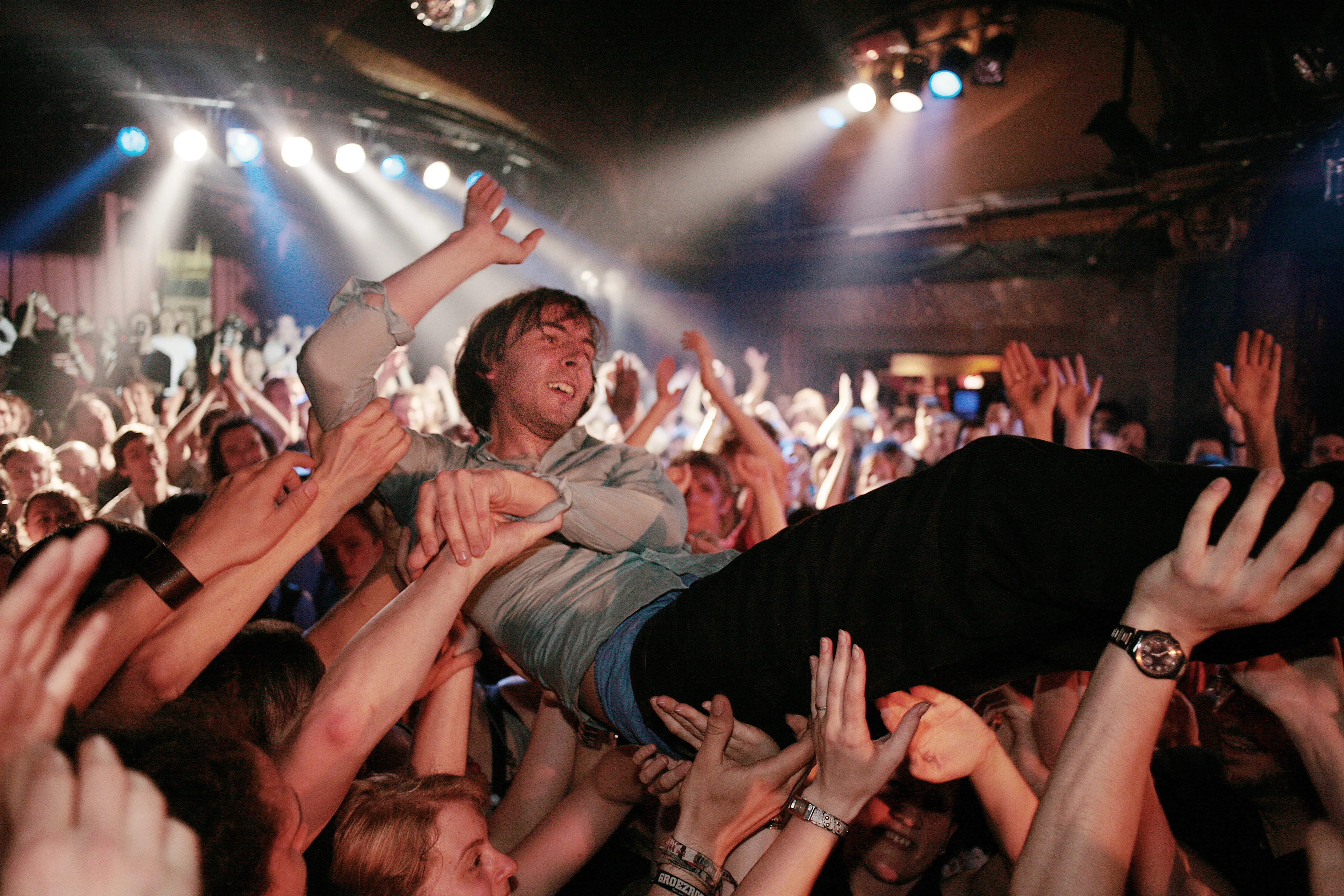
Phoenix
Versailles — International indie pop
Seven albums, one Grammy (2010), and two permanences that never shift. Four Versaillais — Thomas Mars, Deck d'Arcy, Laurent Brancowitz, Christian Mazzalai — who chose English without betraying their geography, and chamber pop without betraying their friendships. A body of work held together by discipline and loyalty.
Why Versailles invented a global pop
Phoenix did not make chanson française. No variété, no dance electronics, no performed Anglophilia. Four Versaillais invented something else: an English-language chamber pop built with the discipline of a string quartet, exported worldwide without losing its home address. The 2010 Grammy is not an accident — it is the reward of a method.
The band was born at Lycée Hoche in Versailles in the mid-1990s. Thomas Mars, Deck d’Arcy, Laurent Brancowitz, Christian Mazzalai — four friends who grew up in the same city as Air, in the same creative generation that produced Daft Punk and the French Touch. Except Phoenix didn’t follow those paths. Mazzalai and Brancowitz played in Darlin’ with Thomas Bangalter and Guy-Manuel de Homem-Christo before the latter founded Daft Punk — a direct biographical link, then a radical divergence of trajectory. Phoenix chose pop over electronics, English over French, construction over dance.
Seven albums between 2000 and 2022 trace a trajectory in four movements: the discreet apprenticeship of the early years (2000–2006), the global tipping point of Wolfgang Amadeus Phoenix (2009), post-success experimentation (2013–2017), and the return to essentials from the Louvre (2022). Not a career that rises and falls — a body of work that searches, explores, and persists.


◆ Musicological studies
The work’s tracks examined closely — device, structure, procedure, lineage, reading under the permanences.

United
A quiet invention. Chamber pop in English, made in Versailles.
Debut album. Versailles, four school friends from Lycée Hoche who release a record in English — without trying to “sound English.” No posturing, no irony. United immediately raises the question: can you make internationally viable indie pop from Versailles, with the seriousness of a chamber ensemble? The answer is yes, and this record proves you don’t need to be from London for that.
The Setup
Constructed pop, mid tempos, clean guitars, melodic bass. No sampling, no heavy electronics — a band that plays together. The production remains sober, almost naive in its textures, which gives it a freshness that holds twenty years later. Too Young is immediate; If I Ever Feel Better runs seven minutes without apology.
Alphabetical
The confirmation. The grammar sharpens, the signature takes hold.
Second album, four years after United. The pressure of the “difficult second record” — living up to a debut that had charmed critics without exploding the charts. Phoenix responds with continuity and deepening: same pop grammar, more refined arrangements, sharper sense of sonic space. Alphabetical confirms that United was no accident.
The Setup
More sophisticated production, discreet strings, Thomas Mars’s voice finding its definitive texture — half-spoken, half-sung, always slightly behind the instrumentation. Everything Is Everything opens like an inevitability. Run Run Run establishes a mechanical rhythm that will become characteristic. The band begins constructing a sound recognizable in two bars.
It's Never Been Like That
The first real international hit. The pop electrifies, the stage explodes.
Third album, and the first to escape the connoisseur circle and reach an international audience. Long Distance Call plays on American radio; Pitchfork and NME rave; Phoenix begins touring massively. The band discovers the stage as a natural extension of the record — a revelation that will define their public identity.
The Setup
More energetic guitars, more direct arrangements, less chamber sophistication and more rock immediacy. Without betraying the established grammar (constructed pop, refusal of excess), It’s Never Been Like That pivots toward something more physical. Consolation Prizes and Rally carry the energy of bands who know they’ll be playing these tracks in front of a thousand people.
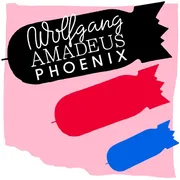
Wolfgang Amadeus Phoenix
The tipping point. Grammy 2010, 1901 everywhere, Phoenix goes global.
Fourth album. The record that changes everything — not through rupture, but through perfection. Phoenix does nothing different from the previous three: they construct elegant, architectured pop without excess. Except this time, two tracks (1901 and Lisztomania) achieve an efficiency that renders them universally irresistible. The Grammy for Best Alternative Music Album follows in January 2010. From cult band to phenomenon: the same band, the same gesture, irreproachable execution.
The Setup
Production with Cassius-adjacent sonic flesh (Philippe Zdar mixed some tracks for the band around this period), more prominent synthesizers, Thomas Mars’s drumming snapping with surgical precision. The title — Wolfgang Amadeus Phoenix — is a Versailles joke about grandeur and lightness simultaneously. Mozart’s name transformed into a band name. Self-deprecation as a posture of excellence.

Bankrupt!
Post-success experimentation. Japanese synths, strange pop, refusal of repetition.
Fifth album, four years after the Grammy. The pressure is inverted: replicating Wolfgang Amadeus Phoenix is impossible; attempting it would be suicidal. Phoenix takes a different direction — more prominent synthesizers, stranger electronic sounds, Japanese influences (Casio music, City Pop). Bankrupt! is a record by a band that refuses to repeat itself, even at the cost of disorienting its audience.
The Setup
Label Loyauté = house label, no major-label pressure. This freedom is audible: Entertainment opens on an unexpected synth motif, Trying to Be Cool plays on obsessive repetition, Bankrupt! (the title track) runs over nine minutes. The band experiments without a safety net, but maintains the first permanence’s discipline — each track has an internal architecture, even when it disorients.

Ti Amo
The Italo-disco concept. Primary colours, a vacation theme with depth.
Sixth album, recorded in Rome. A strong, deliberate concept: Italian disco from the 1970s–80s, primary colours, the Mediterranean summer as a state of mind. Ti Amo is not an album about Italy — it’s an album that uses Italy as vocabulary to speak about love, desire, summer, and suspended time. The most deliberately conceptual exercise in their catalogue, and one of their most successful.
The Setup
Warm synthesizers, funky bass lines, discreet Latin percussion. The sonic palette is consistent from start to finish — you never leave the territory of this imaginary summer. J-Boy is immediate, catchy, almost euphoric. Ti Amo (the track) is softer, almost nostalgic. The conceptual coherence holds without ever tipping into caricature.

Alpha Zulu
The Louvre during lockdown. Stripped-back pop, Ezra Koenig, back to essentials.
Seventh album, recorded in the Louvre’s studios during lockdown (2020–2021). An unprecedented context: an empty palace, a band alone, the world stopped outside. Alpha Zulu carries this atmosphere — more stripped-back pop, less loaded arrangements, as though the absence of an audience had lightened the production. Tonight, featuring Ezra Koenig of Vampire Weekend, bridges two generations of international indie pop that recognise themselves in the same discipline.
The Setup
Recording in the exceptional setting of Radio France’s studios at the Louvre. The resonance of empty spaces is audible in the sonic texture — something slightly more airy, more organic. Ezra Koenig on Tonight is not a marketing feature: it’s two bands from the same aesthetic territory (constructed international indie pop) recognising each other. The result is natural, no visible seam.
A body of work in four movements
Twenty-two years of studio work, seven albums, one Grammy. Phoenix’s trajectory breaks into four distinct movements — each testing a different dimension of the grammar established in 2000, without ever betraying it.
What never changes
Two permanences run through all four movements. Versaillaise chamber pop as exportable material — each album is an architectural proposition in English, never a generic product. The friendship lineage as a longevity strategy — four members since high school, no departures, no dissolution. These two gestures, established in 2000, haven’t shifted by a line in twenty-two years.
The Versailles lineage
Phoenix shares more than a city with Air: a posture. The same refusal of emphasis, the same long-term view, the same care for timbre. Thomas Mars sings on Air’s Playground Love — a direct musical link between the two catalogues. Both bands represent the two faces of Versailles in world pop: Air with chamber-electronic instrumentals, Phoenix with sung chamber pop. Two parallel trajectories that don’t merge but recognise each other.
The map
Seven albums orbiting the two constants. Click an album to see how it plays them out.
Friendship lineage: four members, no dominant ego, collective production.
Position: the quiet invention. The grammar born complete.
Friendship lineage: same human chemistry, no lineup change.
Position: the confirmation. United was no accident.
Friendship lineage: first major international tour, four members intact.
Position: the first real international hit. The stage revealed.
Friendship lineage: Grammy, Coachella — four members together.
Position: the tipping point. Grammy 2010. From cult to phenomenon.
- 1901 The absolute pivot hit. Phoenix's irreproachable pop mechanism at peak efficacy — without ever betraying itself. Read the analysis →
- Lisztomania The opening single of Wolfgang Amadeus Phoenix. European Romantic vocabulary, 21st-century indie pop, and the viral origin of a decade of fan-edits. Read the analysis →
Friendship lineage: least accessible record; four members defend it on tour.
Position: the experimentation. The band refuses to repeat itself.
Friendship lineage: collective vision accepted — getting lost in the same setting.
Position: the concept. Italian disco, primary colours, Rome.
Friendship lineage: 27 years together, same lineup — Ezra Koenig as outside witness.
Position: the essentials. Return to the stripped-back from an empty palace.