Daft Punk
Paris — French Touch · Robots
Twenty-eight years, four studio albums and two live records — from Homework, recorded in a Parisian apartment, to Random Access Memories, captured with the most demanding session musicians in Los Angeles, by way of the two live milestones Alive 1997 (Birmingham, released 2001) and Alive 2007 (the Martin Phillips pyramid). Daft Punk rests on two gestures: the helmet as the erasure of the face and the loop as argument. They are the artists who transformed club discipline into a planetary language, without ever yielding on structural rigour.
Why the helmet is the argument
Daft Punk did not invent filtered French Touch — they pushed it to its formal limits. Thomas Bangalter and Guy-Manuel de Homem-Christo come from the same Paris of 1994–1997 as Cassius, Étienne de Crécy or Bob Sinclar: the same signal chain, the same disco sample, the same low-pass filter in automation. But where their contemporaries gradually loosened the constraint, Daft Punk radicalised it — all the way to a global number one single that is still a four-bar loop, all the way to a concept film that illustrates an entire album without a word of dialogue.
Two founding gestures, constant from 1997 to 2021. First, the helmet — adopted in 1999 as a deliberate aesthetic position: erase the face so the work speaks alone. Then, the loop — not as laziness but as architecture: Around the World (seven minutes, one loop, twenty ostinatos), One More Time (house as total emotional climax), Get Lucky (funk guitar played live, global number one, no harmonic development). These two permanences are not styles — they are decisions.
The four pivot albums that follow trace the arc: Homework (1997) — the filter-house manifesto recorded at the Daft House; Discovery (2001) — the disco-pop masterpiece with helmets; Human After All (2005) — the gamble of brutal stripping back; Random Access Memories (2013) — the return to live recording with the pioneers. Between Human After All and RAM, the Alive 2007 tour — Martin Phillips’s pyramid that redefined the electronic concert. Then silence, and in 2021, the separation.
French Touch has its axes. The filtered studio axis: at Cassius, the same gesture — sample, filter, pump — but in service of groove as discipline first, and chanson second. At Daft Punk, in service of the loop as architecture first, and international pop second. Two Parisian duos, signed simultaneously at Source/Virgin in 1997, who answered the same constraint with two different radicalisms.


◆ Musicological studies
The work’s tracks examined closely — device, structure, procedure, lineage, reading under the permanences.



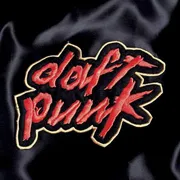
Homework
The manifesto of filtered French Touch, recorded in a Parisian apartment.
Homework was born in a Parisian apartment — the Daft House on rue Abbesses in the 18th arrondissement. No professional studio, no session musicians, no budget. Roland drum machines, a sampler, synthesisers — and one rule: the loop must hold on its own. The title Homework is a self-deprecating joke that says exactly what it means: this is bedroom work. The result launched Daft Punk onto the international stage within months.
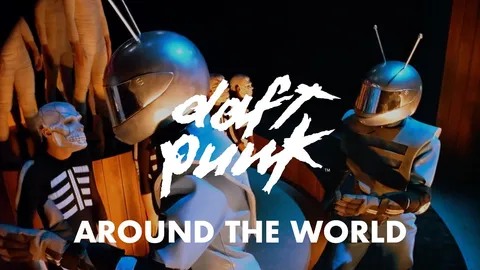
In January 1997, French Touch was still a confidential Parisian phenomenon. Homework made it globally visible — not only through sound but through images. Michel Gondry directed the Around the World video: twenty choreographed dancers in distinct groups (skeletons, robots, swimmers, orchestra, funky dancers) — each group representing a specific sonic layer in the mix. Spike Jonze directed Da Funk: a dog-headed character wanders through Manhattan in silence, a cassette player his only link to the world. Two visions, no faces of the duo. The rule was set before the helmets even existed.
The device
The grammar of Homework is that of the French filter house: take a disco or funk sample, automate a low-pass filter, let the sidechain pump create the movement. Thomas Bangalter had already experimented with this gesture on his Roulé solo maxis. Homework was the first time the method was applied over the span of an album, with stylistic consistency and international ambition. The album does not play a style — it is a style.
“Around the World is not a track that develops. It builds. Those aren’t the same thing.”— Thomas Bangalter, Red Bull Music Academy, 2013 (paraphrase)
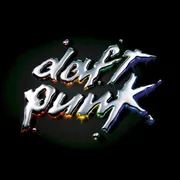
Discovery
The pop masterpiece. From filter house to international disco, without abandoning loop discipline.
In 1999, the helmets appeared. Daft Punk chose to erase their faces at the precise moment celebrity culture was becoming the dominant mode of pop. This was not a strategy — it was an aesthetic position. And it is behind these helmets that Discovery arrived in 2001, transforming filtered French Touch into a global pop language.
Discovery is built on the heroes of Bangalter and Guy-Manuel: ELO, Alan Parsons Project, Chic, Slauson Brothers. The 1970s–80s disco reference is not revivalism — it is a radical, filtered, augmented rereading. Romanthony (Anthony Wayne Moore, 1967–2013, New Jersey vocalist-producer working in the Chicago house orbit) sings One More Time, his voice entirely vocoded until the final climax where it breaks free in the clear — a dramatic gesture unique in electronic production of the period. The animated film Interstella 5555 by Leiji Matsumoto was released simultaneously, illustrating the whole album without a single word of dialogue.
The device
The robot-persona now structures the work at several levels. Visually: helmets at every public appearance. Musically: the voice is systematically treated — One More Time (vocoder), Harder Better Faster Stronger (robotic auto-tune), latent string-processing throughout. Vocal technology is used not as effect but as commentary on the mediation between sound and the human who produces it. In 2001, before auto-tune became a cliché, this gesture was radical.
“We wanted to make an album that sounds as if aliens had discovered an old record of human music and were trying to reproduce it.”— Guy-Manuel de Homem-Christo, press interview (2001, paraphrase)
Alive 1997 — the pre-helmet capture
Between Discovery (March 2001) and Human After All (March 2005), Daft Punk released a strange object in October 2001: Alive 1997. Forty-seven minutes of a single continuous track, recorded on 8 November 1997 at the Que Club in Birmingham — four years earlier. It is an archive-record, a delay-record, a record that returns to the last moment when Bangalter and Guy-Manuel appeared on stage without helmets.
The recording’s context matters. November 1997: Homework has been out for ten months, the duo is touring Europe with a minimal setup (two podiums, projections). At the Que Club that night, they play a continuous DJ set — not a concert in the rock sense, but a long mixing session where the Homework tracks pass at 110 BPM, are stretched into ten-minute versions, are re-cut in different loops than the studio. No helmets. No pyramid yet. Just two guys mixing their own album in an English club.
The editorial decision to release in 2001 — that is, after adopting the helmets in 1999 and after Discovery — is strategically deliberate. Daft Punk wait until the robot-persona is installed to reveal the capture from before. It is a reintroduction of the face by contrast: you hear what it sounded like when they were still visible, you measure the difference with what they have become. The helmet-permanence is defined here by opposition. Before, they were men; after, they are work-machines. Alive 1997 documents the frontier.
Formally, the record invents something. Forty-seven minutes on a single track — no intermediate indexing, no separation between songs. The listener cannot skip to Da Funk or Around the World; they must traverse the entire mix, in the exact order it was played. This is rare for an electronic live album in 2001 — most club-scene live records (Sasha & Digweed, Paul Oakenfold) cut their sets into 4-6-minute tracks to ease listening. Daft Punk refuses this carving. The mix is the work, not the songs that compose it. This is the same grammar as Around the World at a larger scale: the loop as total architecture, duration as argument.
The other structural interest: what you hear on Alive 1997 is not Homework. It is Homework reconfigured. Da Funk is played at a faster tempo, Around the World is interwoven with Burnin’, Rollin’ & Scratchin’ appears in a longer version than on the studio record. The set demonstrates that the Homework tracks are not songs but materials, modifiable, recombinable, elastic. This malleability prefigures exactly what Alive 2007 will do six years later with Human After All — rehabilitation through mashup.
The influence is less spectacular than Alive 2007’s, but it is real for producers: Justice (the Augé/de Rosnay duo) cite Alive 1997 as the object that made them understand a live record could be something other than a best-of. James Murphy (LCD Soundsystem) mentions it in interviews as the reference for the recorded continuous set, in lineage with the underground tapes of Larry Levan at Paradise Garage. The record does not sell massively at release — it is understood years later.
And it prepares Alive 2007 through the gesture: Daft Punk demonstrate, six years before the Martin Phillips pyramid, that the live is not a by-product of the studio. The studio makes the album, the live makes another work. This distinction — banal in jazz, almost unknown in electronic pop in 1997 — is laid down by Alive 1997. When Alive 2007 arrives with its mashups and its pyramid, it will execute visually what Alive 1997 laid down sonically: two different records for two different media.
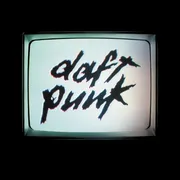
Human After All
Six weeks, harder sound. The gamble of bare repetition against post-Discovery overproduction.
Six weeks of recording. That is all Daft Punk allowed Human After All — deliberately. After four years digesting the massive success of Discovery, the duo chose the antipode: hard sound, bare lines, bold repetition, rough synthesisers. The cover is blood red. The title poses a question: after the robot-persona of 1999, after the helmets and vocal technology of Discovery, are they still human?
The answer is not simple. Human After All was received coolly on its 2005 release — too repetitive, too raw, too underdeveloped compared to Discovery. Critics and fans were unsettled. But Alive 2007 changed everything: in concert, with Martin Phillips’s light pyramid, each track on this album took on a dimension the studio recording had never suggested. Robot Rock in mashup with Eurythmics’ Oh Yeah. Technologic layered over Around the World. The repetition was not a flaw — it was material for the live.
The device
Human After All radicalises loop discipline through stripping back. Where Around the World stacked twenty layers, Robot Rock lays two or three and holds them. Where Harder Better Faster Stronger used word permutation as concrete poetry, Technologic chains eighty technological verbs without punctuation or rest. This is repetition pushed to hypnosis — a minimalist gesture in the club register, close to Steve Reich in the academic register. Two disciplines, one principle.
“We recorded in six weeks because we wanted to find immediacy again, danger. Discovery had become too polished.”— Thomas Bangalter (paraphrase, 2005 interviews)
The pyramid that changed everything — Alive 2007
Between Human After All (2005) and Random Access Memories (2013), Daft Punk released no studio album for eight years. But in 2006 and 2007, they did something else — something that would redefine what it means to “play live” in electronic music for the next two decades.
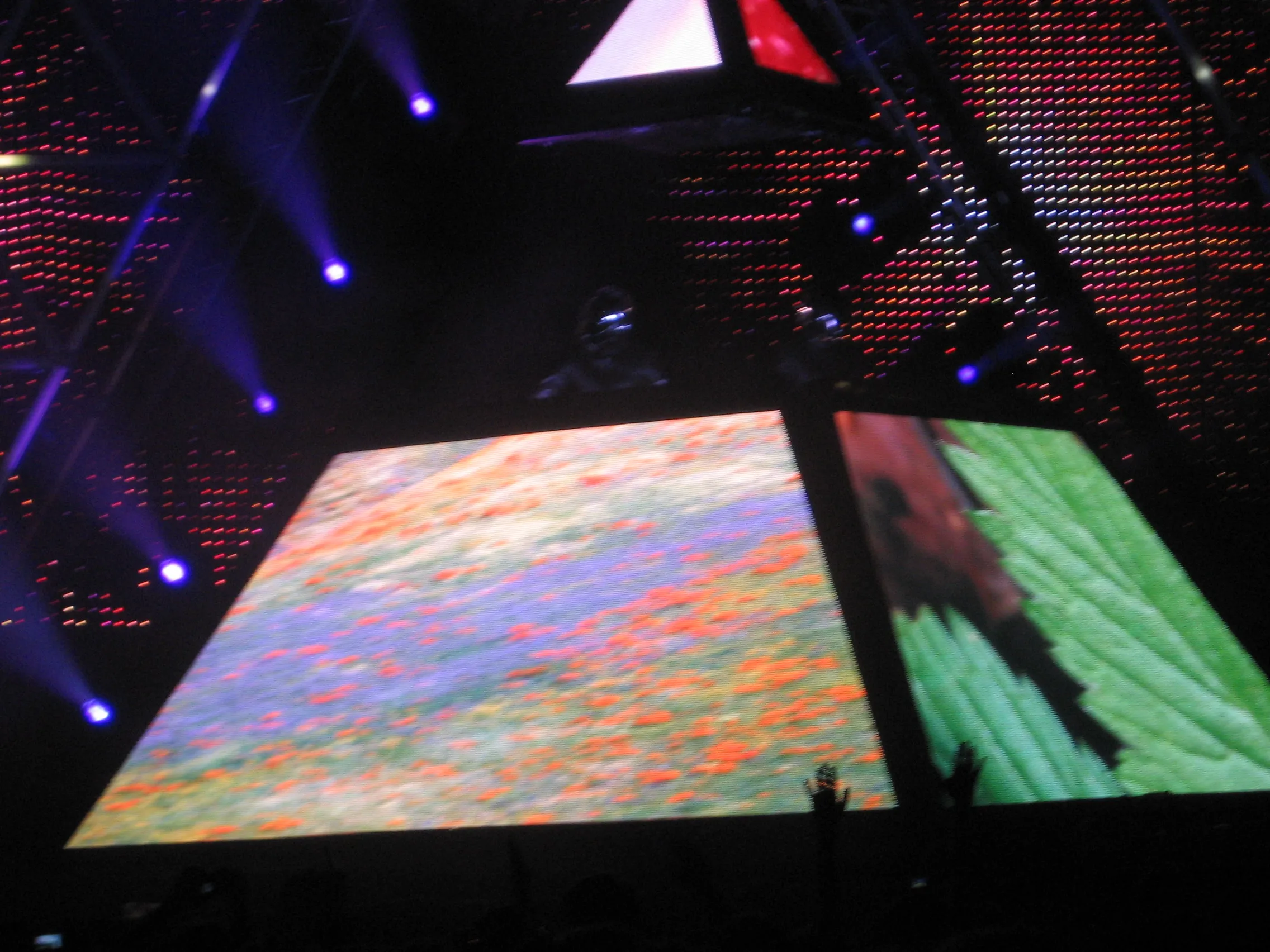
The pyramid. Designed with designer Martin Phillips, the Alive 2007 stage is a triangular structure several metres high, entirely covered in LED screens and lights controlled in real time. Bangalter and Guy-Manuel perform inside it, invisible in the structure except for their illuminated helmets. Coachella 2006 is the first concert of this tour — filmed on mobile phones, uploaded to YouTube (still new), it goes viral before that word existed in its contemporary sense. The footage circulates for months. Everyone wants to understand how two men inside a pyramid can do this.
What the pyramid does is make the structure of the tracks visible. The LED bands change colour and rhythm to the millimetre of the mix. Every transition, every filter opening, every kick triggers a light response. The central argument of Daft Punk — the loop as architecture — literally becomes luminous architecture. This is no longer electronic spectacle. It is a visual score.
And Human After All, the album critics had dismissed in 2005 for its repetitiveness, took on another dimension. Robot Rock interwoven with Eurythmics’ Oh Yeah. Technologic layered over Around the World. Harder Better Faster Stronger in mashup with Technologic. The most austere tracks became the best live material — because their austerity was precisely what made them flexible, mouldable, capable of bearing other layers without collapsing.
The influence of this tour is direct and measurable. Swedish House Mafia, Deadmau5, Skrillex — the entire EDM scene exploding between 2008 and 2014 cites Alive 2007 as a reference. The pyramid inspired dozens of elaborate stage designs. Coachella became the reference site for electronic concerts in part because Daft Punk had shown what was possible there. When the duo returned in 2006, then 2007, each concert was no longer a club event but a global popular culture event.
The live Alive 2007 was released in November 2007, recorded in Paris (Bercy). It won the Grammy for Best Electronic/Dance Album in 2009. Then Daft Punk disappeared again — six years of silence before Random Access Memories. The pyramid was perhaps their most complete work. Not an album — a presence.
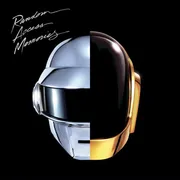
Random Access Memories
Grammy AOTY. Recorded live with Nile Rodgers, Pharrell, Giorgio Moroder — the loop carried to orchestral scale.
Eight years of discographic silence between Human After All (2005) and Random Access Memories (2013). In the interval: the Tron: Legacy soundtrack (2010), a handful of scattered collaborations, and underground work that would culminate in the duo’s most ambitious album. The rule was inverted: instead of the all-synthetic approach of Homework, everything would be played live, in the studio, by real musicians.
The cast is vertiginous. Nile Rodgers (Chic) plays the rhythm guitar on Get Lucky and Lose Yourself to Dance — his pick strokes are the album’s loop. Pharrell Williams sings Get Lucky and Lose Yourself to Dance. Giorgio Moroder — the father of electronic music in 1970s Berlin — narrates his own story in Giorgio by Moroder (9 minutes): how he discovered the Moog, how he invented electronic disco. Paul Williams (author of Evergreen and hundreds of standards) co-writes the lyrics. Julian Casablancas (The Strokes) sings Instant Crush. Nathan East, Omar Hakim, Todd Edwards — every musician is a legend in their field.
The device
Nile Rodgers’s loop on Get Lucky is the synthesis of the entire body of work: four bars of funk guitar, played live, without a single modification, repeated for four minutes. No bridge, no modulation, no harmonic development. This is exactly the same rule as Around the World in 1997 — but with a human guitarist instead of a synthesiser. The discipline is identical; the medium has changed. It is the permanence of the loop applied to the live format and carried to global number one.
“We wanted to make an album that celebrates the people who invented our music — Moroder, Nile, Paul Williams. Thank them by building with them, not by sampling them.”— Thomas Bangalter, Pitchfork interview (2013, paraphrase)
A body of work in four movements
Twenty-eight years, four studio albums, two live records (Alive 1997 and Alive 2007), and a separation announced without voices or faces. Daft Punk’s trajectory divides into four clear movements — each one testing a new facet of loop-discipline and the helmet-device, until their final achievement in Random Access Memories.
What never changes
Two permanences run through all four movements. The helmet as device — from 1999 to 2021, every public appearance, every video, every album erases the face so the work speaks alone. The 2021 separation is announced without voiceover: the permanence carried to its logical conclusion. The disco sample at its structural extreme — from the four-bar loop in a Parisian apartment (1997) to Nile Rodgers’s guitar played live without harmonic development (2013), the rule of loop discipline does not change. Only the medium evolves: synthesiser, vocoder, living musician.
The bridges that hold
The Parisian French Touch of 1994–1999 is a precise ecosystem. Cassius and Daft Punk were signed simultaneously at Source Records/Virgin in 1997. Bangalter co-produced Stardust’s Music Sounds Better with You (1998) — on Roulé, the sister label of Source. Philippe Zdar stated in interviews that Homework directly influenced his approach to 1999. Two duos, same year, same label, same filter-house grammar — but two distinct radicalisms: Cassius toward groove as discipline, Daft Punk toward the loop as architecture. This bridge is factual. It is the only one that counts.
Daft Punk’s effect on 2000s–2020s pop is measurable in a chain of tributes. Harder, Better, Faster, Stronger (2001, Edwin Birdsong 1979 sample) is itself sampled by Kanye West on Stronger (Graduation, 2007) — Billboard number one, five million US units. Bangalter and Guy-Manuel join Kanye on stage at the 2008 Grammy Awards, helmets + Kanye, sealing the French Touch / mainstream hip-hop cultural bridge. Then the inverse operation on Random Access Memories: summon the elders (Moroder, Rodgers, Paul Williams) to the studio and have them play their own grammar in 2013. The living careers of Moroder and Nile Rodgers explode after RAM — the Daft Punk tribute relaunches their personal trajectories. The permanence is not commemorative. It is productive.
In 2023, Thomas Bangalter releases Mythologies for the Ballet de l’Opéra de Bordeaux — without a helmet, under his own name, for orchestra and choir. The first public appearance post-Daft Punk. The permanence of the helmet applied to the Daft Punk project, not to the man. What does not disappear is the structural rigour: Mythologies rests on the same principles of repetition and loop as Around the World — in another medium. The grammar outlives the device. The helmets were the tool; loop-discipline was the project.
The map
Four albums in orbit around the two permanences. Click an album to see how it declines them.
Loop: Around the World — 7 minutes, one loop, 20 choreographed ostinatos. Loop discipline at its founding state.
Position: manifesto. Daft House, apartment studio, global French Touch.
- Around the World Seven minutes, one loop, twenty choreographed ostinatos. Loop discipline at its founding state — Michel Gondry makes visible what sound alone imposes. Read the analysis →
- Da Funk The single that took Daft Punk from Glasgow Soma to global Virgin. Five synth notes filtered over a funky kick, and a dog-headed character wandering through Manhattan, filmed by Spike Jonze. Read the analysis →
Loop: One More Time — Romanthony's vocoded voice held back, released once. Harder Better Faster Stronger — word permutations as loop.
Position: pop masterpiece. French Touch at international scale.
- Harder, Better, Faster, Stronger Four verbs, four adjectives, twenty-one permutations. An Edwin Birdsong loop, a vocoded voice turned into concrete poetry. The grammar of future Kanye West, six years before Stronger. Read the analysis →
- One More Time Vocoded disco-house and a liberated climax — Romanthony's voice held by the robot, then released only once. Daft Punk at the summit of pop discipline. Read the analysis →
Loop: six weeks, hard sound, bare repetition — Robot Rock (3 elements, 7 minutes), Technologic (80 verbs, hypnosis).
Position: divisive album. Rehabilitated by Alive 2007.
Loop: Get Lucky — Nile Rodgers guitar played live, 4 bars, global number one, no harmonic development.
Position: Grammy AOTY. Live loop as arc climax.
- Get Lucky (feat. Pharrell Williams, Nile Rodgers) Four minutes, a guitar loop played live by Nile Rodgers, a Pharrell Williams chorus. Number one in 32 countries. French loop-discipline carried to the mainstream pop format without a single capitulation. Read the analysis →
- Giorgio by Moroder Nine minutes. Giorgio Moroder narrates the night he invented electronic disco; then Daft Punk reply by doing exactly what he invented. The meta-track of the body of work — tribute becomes the structure itself. Read the analysis →