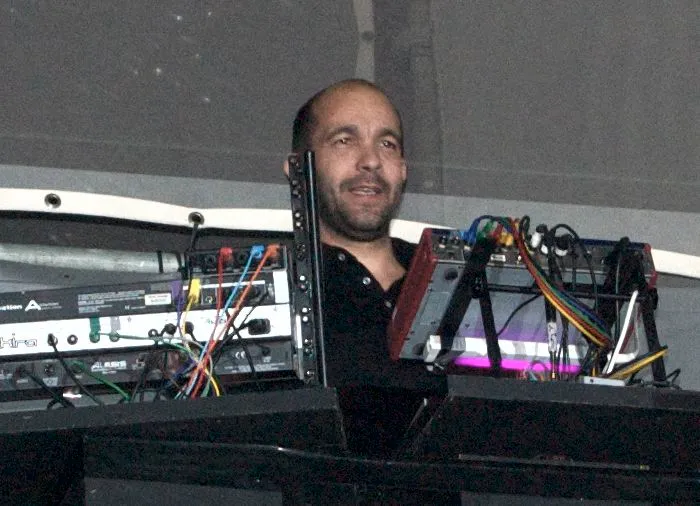
Étienne de Crécy
Paris — French house auteur
Twenty-eight years, five pivot albums, a stage object built from 2,828 metres of LED tubes. Étienne de Crécy never sought the spotlight — he built a format. The collective compilation as editorial signature, the solo album as proof of mastery, the live set as luminous sculpture. French Touch from the inside, without compromise, without stardom.
Why the compilation is an authorial act
In 1997, Étienne de Crécy released Super Discount. Not his solo album. Not a DJ mix. Not a scene anthology. A authorial format: a compilation where every track was composed for the project, where guests (Air, Alex Gopher, La Funk Mob) work within a defined sonic framework, where the signature belongs not to an artist but to a label — Solid. Twenty-eight years and two sequels later, that format still stands. The compilation as a collective book of which he is the editor.
De Crécy was born on 25 May 1969 in Lyon. Trained at the Versailles Conservatoire, he joined the orbit of the Parisian La Funk Mob collective in the early 1990s — the same collective that intersected with Cassius, with the Parisian pre-French Touch club underground. Super Discount arrives in 1997, the same year as Daft Punk’s Homework. Two visions of French Touch: Daft Punk seeks robotic pump and stardom; de Crécy seeks collective work and authorial erasure.
Five pivot albums unfold these permanences: Super Discount (1997) founds the format, Tempovision (2000) proves he can do it alone, Super Discount 2 (2004) confirms the framework’s durability, Super Discount 3 (2015) tests generational transmission, and Warm Up (2025) opens toward an unprecedented international dimension. Between SD2 and SD3, the Cube — not an album, but a stage-object that deserves its own reading.
French Touch has its axes. The dancefloor axis: Cassius and their filtered studio in service of groove. The chamber axis: Air and their vintage timbres. De Crécy sits at the crossing: he makes dancefloor music, but he is an editor. The bridge with Cassius is factual — same La Funk Mob generation, same Solid, same refusal of stardom — and aesthetic: two different ways of treating the filtered sample as raw material.


◆ Musicological studies
The work’s tracks examined closely — device, structure, procedure, lineage, reading under the permanences.
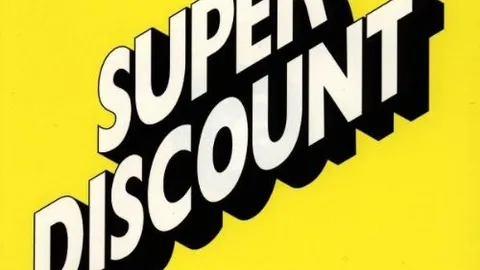

Super Discount
The founding grammar. Collective filter house, nonchalant, without a frontman.
The record that sets the grammar. Super Discount arrives in 1997, contemporary with Daft Punk’s Homework — the other face of French Touch. Where Daft Punk seeks robotic pump, Étienne de Crécy assembles a collective: Air (Modulor Mix), Alex Gopher, La Funk Mob, St Germain, Dimitri From Paris. No frontman, no artist logo, just a label — Solid.
The format is new. This is not a compilation of existing tracks, not a DJ mix: each track was composed for the series. Étienne de Crécy acts as editor as much as producer — he defines a sonic framework, the guests slip into it. Filtered house as a shared language, groove as shared discipline.
The device
Square filter house: low-pass filter in automation, 8-bar loops, no conventional verse/chorus. Tracks build in stages — the progressive opening of the cutoff creates the drama. No lead vocals, no obvious single. The album is a block — you listen to it whole or not at all.
“Super Discount is an editorial act as much as a record.”— press paraphrase
Tempovision
The solo pivot. Proof that he can write an album from start to finish.
Three years after Super Discount, Étienne de Crécy releases his first conventional solo album. Tempovision is a demonstration: yes, he can write a coherent 62-minute album without collective safety nets, without the compilation format. The album holds the distance.
Am I Wrong is his best-known track — a Stevie Wonder sample (I Was Made to Love Her) filtered, dubbed, vocals chopped to a silhouette. French house transforming American soul without reverence. Scratched and Tempovision reinforce the point: de Crécy masters the album format as well as the compilation format.
The device
Filter house more tense than Super Discount — deeper bass, more pronounced sidechain. The production has matured over three years. No main vocals (beyond treated samples), no conventional song structure. The album unfolds like a coherent long mix — but it is an album, not a mix.
“Tempovision is proof he didn’t need others to make a strong record.”— critical paraphrase
Super Discount 2
The compilation returns. Darker, more club-oriented — house that has matured.
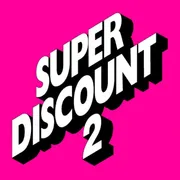
Seven years after Super Discount, the format returns. Super Discount 2 keeps the editorial logic — authorial compilation, unified sonic framework, guests within the format — but the music has changed. It is 2004, French Touch has passed, house has hardened. The bass goes deeper, the sidechain is more aggressive, the tracks are darker.
Guests include Romanthony, Alex Gopher (faithful since SD1), and DJs from the Parisian underground scene. No Brain and Fast Track are the singles — the first cold irony, the second a race against time. The authorial compilation format holds over seven years: the Solid grammar remains legible.
The device
Filtered house but more tense — slightly higher tempo, more aggressive compression, less open filters. The warmth of SD1 has given way to clinical efficiency. The format remains the same: no frontman, unified editorial framework, tracks composed for the series. But the tone has shifted — from nonchalance to discipline.
“No Brain is the funniest track on the record — and the most effective.”— critical paraphrase
The Cube — when music becomes sculpture
Between Super Discount 2 (2004) and Super Discount 3 (2015), eleven years of discographic silence. But not silence altogether. In 2008, Étienne de Crécy deploys the Cube: 2,828 metres of LED tubes, a cubic structure 8 metres per side suspended above the stage, designed with designer Olivier Pasquet. The stage-object as album.
The Cube refuses the dominant aesthetic of late-2000s electronic live performance — the DJ behind decks, the crowd below, the artist invisible. De Crécy proposes the inverse: an object impossible to ignore, imposing its visual presence before the first kick drops. Electronic music as sculpture as much as sound.
The staging is not a backdrop. The LED tubes respond to music in real time — programming handled by Pasquet, whose work merges design, code and visual art. Each track generates a different light choreography. Object and music form a single body — removing the LEDs would be like playing without bass.
The Cube tours from 2008 to 2014, across European and American festival stages. There is no proper Cube record — Beats’n’Cubes (2011) captures its energy, but the project is fundamentally a scenic object, not a recording. It is to Étienne de Crécy what visual stagings are to rock — a way of saying that live performance is not an impoverished version of the album, but an autonomous medium.
When Super Discount 3 arrives in 2015, the Cube accompanies the tour. The stage-object is not abandoned — it evolves with the repertoire. De Crécy remains faithful to his permanence: music as total object, from sound to space. Not a marketing gimmick. An aesthetic position.

Super Discount 3
The generational return. Madeon, Vladimir Cauchemar, Alex Gopher — the series crosses eras.
Eleven years after Super Discount 2, the format returns for a third time. And this time, something has changed: the guests are no longer only peers from the Parisian 1990s scene, but the next generation. Madeon (22 in 2015), Vladimir Cauchemar, Alex Gopher (faithful since SD1), Baxter Dury.
The format withstands eighteen years of change. You (with Madeline Follin) is the most directly accessible track in the series — almost pop, almost a love song. WTF (with Pos & Dave) is relaxed irony. French Touch has not been reactivated — it simply continued, discreetly, outside of trend.
The device
The production has evolved again — samples are less obvious, synthesizers more organic, house less filtered and more open. In 2015, heavy filtering would be retrograde. De Crécy adapts the framework without betraying it: the editorial format remains, the sonic grammar has matured.
“Super Discount 3 proves the format was not a youthful accident.”— press paraphrase

Warm Up
The international opening. Damon Albarn, Kero Kero Bonito, Caroline Rose — house crossing genres.
2025. Ten years after Super Discount 3, Étienne de Crécy returns with a solo album — his first properly since Tempovision in 2000. Warm Up is different from everything before: collaborators are international (Damon Albarn, Kero Kero Bonito, Master Peace, Olivia Merilahti, Caroline Rose), registers span from house to chamber pop to indie.
Rising Soul with Damon Albarn is the centrepiece — Albarn in meditative Gorillaz mode over a de Crécy house carpet. Small Screen with Kero Kero Bonito is the surprise — unlikely j-pop-house that works. The mastery is intact, the taste for collaboration too, but the editorial framework has changed: this is no longer the Super Discount series, it is an album of invitations.
The device
The production is more airy than previous albums — less compression, more space, more organic synthesizers. Filtered house is still there, but as a watermark. The boundary between house and chamber pop is porous — sometimes the groove dominates, sometimes the melody.
“Warm Up is not a French Touch album — it is simply a French album.”— press paraphrase, 2025
A body of work in four movements
Twenty-eight years, five pivot albums, a stage object built from 2,828 metres of LED, collaborators ranging from the Parisian La Funk Mob to Damon Albarn and Kero Kero Bonito. Étienne de Crécy’s trajectory breaks into four movements — each testing a different dimension of the format he invented in 1997.
What never changes
Two permanences traverse the four movements. The compilation as authorial format — from Super Discount to Warm Up, it is always the same gesture: define an editorial framework, invite artists to work within it, guarantee sonic coherence without stardom. Format takes precedence over signature. The scenic object as music’s extension — from the LED Cube to the design aesthetic of the covers, de Crécy refuses to separate sound from space. Music as total object.
The bridges that hold
The French Touch of 1996–2000 is an ecosystem more than a genre. Cassius and de Crécy share the same origin orbit — La Funk Mob, the Solid label, the refusal of stardom. The studio as instrument at Cassius (Zdar at the console), the format as instrument at de Crécy (the compilation as writing). Two neighbouring disciplines, two refusals of easy pop. The bridge is built through a shared demand for sonic rigour.
Air appears on Super Discount (1997) — Modulor Mix. The factual is there: de Crécy invites Air into his format, Air accepts. Two approaches to French Touch: Air seeks vintage timbre and the chamber, de Crécy seeks filtered groove and the dancefloor. Same era, two destinations.
The map
Five albums orbiting the two permanents. Click an album to see how it declines them.
Stage object: aged-gold sleeve without an artist photo — the format takes precedence over personality from the very first gesture.
Position: co-contemporary with Homework (Daft Punk, 1997) — but the opposite gesture. Daft Punk signs, de Crécy erases the signature. Collective filter house as programme.
Stage object: red geometric sleeve — darker, more design-minded aesthetic than SD1. Visual intent persists even in the solo format.
Position: demonstration: 62 minutes, no collective safety net, distance held. Am I Wrong — filtered Stevie Wonder sample. French house transforming American soul.
Stage object: industrial-green sleeve — each instalment of the series carries its own strong visual identity. The compilation as design system.
Position: tougher house, deeper bass, more aggressive sidechain. 2004, the French Touch has passed — de Crécy adapts the frame without betraying it.
Stage object: the LED Cube (2008–2014) in the background — the staging remains present in SD3 tours. Music and object inseparable.
Position: You (Madeline Follin) — almost pop, almost a love song. French Touch learning melody without losing the groove.
Stage object: clean visuals, persistent design aesthetic. Music as total object, even in the international opening.
Position: first solo album since Tempovision (2000). House-to-chamber-pop, borders porous. Rising Soul (Albarn) — two sobrieties recognising each other.