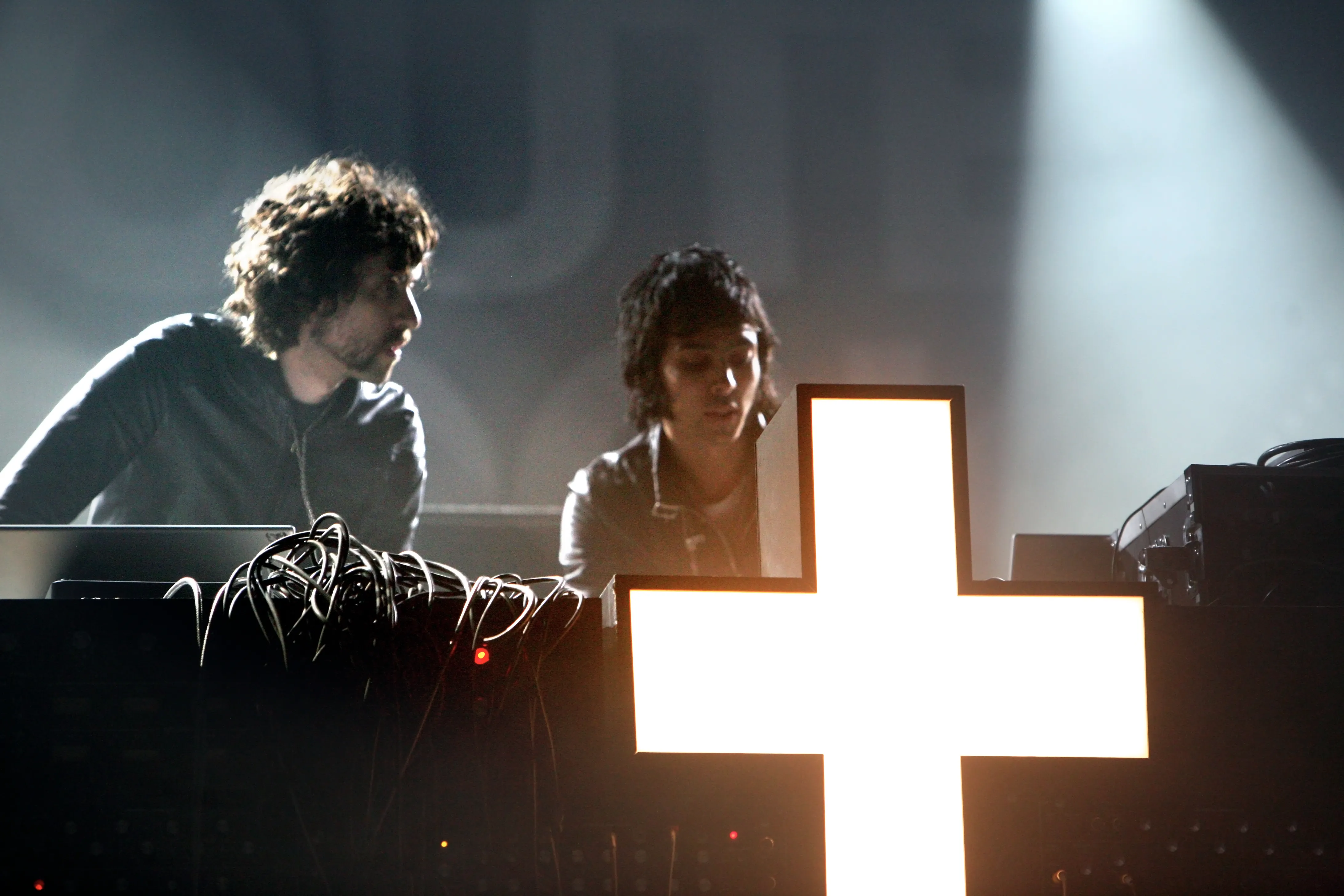
Justice
Paris — Electro · Ed Banger
Twenty years, four studio albums and a foundational live record — from †, recorded in Parisian studios in 2006–2007, to Hyperdrama, captured with Kevin Parker, Thundercat and Connan Mockasin in 2024, by way of the prog-rock turn of Audio, Video, Disco. and the disco-funk pivot of Woman. Justice rests on two gestures: saturated rock as dance music — distortion guitar and four-on-the-floor kick fused without one consuming the other — and classical-baroque citation as raw material — harpsichords, choirs, fugato structures inserted into the club flow without irony. They are the artists who made musical violence pop.
Why the cross is a decision
Justice did not invent rock-electro fusion — producers like The Prodigy or Death in Vegas had already crossed guitars and kicks before 2007. But Justice was the first to make this fusion a total aesthetic position, without compromise, without safety net, at the precise moment when the boundary between club and rock arena was dissolving. † arrives in 2007 as a loud, self-evident statement: this is what 1970s rock and 1990s house should have done together from the start.
Two founding gestures, constant from 2007 to 2024. First, saturated rock as dance music — not electro-rock in the Chemical Brothers mode (guitars added to an electronic production) but a structural fusion, where distortion is a production texture on the same footing as the synthesiser and the kick. Then, classical-baroque citation as raw material — harpsichords, choirs, fugato structures inserted into the club flow not out of culture or irony, but because these repetitive structures of the baroque are functionally compatible with the loop of house music. These two permanences are not styles. They are technical decisions.
The four pivot albums that follow trace the arc: † (2007) — the rock-electro fusion manifesto; Audio, Video, Disco. (2011) — the unveiling of rock-classical sources; Woman (2016) — the disco-funk pivot, testing the permanences without their obvious markers; Hyperdrama (2024) — the collaborative, cosmic return, twenty years on. Between † and AVD, the A Cross the Universe tour (2008) — live document of the inaugural peak.
The French lineage has a precise address. Daft Punk and Justice share a human link: Pedro Winter (Busy P), Daft Punk’s manager until 2003, founds Ed Banger Records that same year and signs Justice as the first artist of his generation beyond Daft Punk. The French Touch of 1997 (Daft Punk, Cassius, Étienne de Crécy — sample, filter, pump) gives rise to the French Electro 2.0 of 2007 (Justice — rock, distortion, cross) through this single bridge figure. Thomas Bangalter, under his Roulé label, produced Stardust’s Music Sounds Better with You in 1998 — the first track to treat the voice as melodic texture in an electronic flow, a gesture that D.A.N.C.E. (2007) takes up and systematises. The bridge is factual. It is the only one that matters.


◆ Musicological studies
The work’s tracks examined closely — device, structure, procedure, lineage, reading under the permanences.

†
The manifesto. Saturated rock, baroque harpsichord, children's choir — Justice lays down all its markers in a single record.
In 2007, Justice released † and imposed a sonic self-evidence that had not yet been heard: the rock guitar of the 1970s, the saturated bass of Black Sabbath, the harpsichord that sounds like Bach — all of it in a club, on a four-on-the-floor kick, with a children’s choir singing Michael Jackson. Impossible in theory. Immediate in practice.
The album was produced in Paris, co-produced with Ed Banger Records — the label of Pedro Winter (Busy P), Daft Punk’s former manager. This context is structural: † sits in the continuity of the French Touch while frontally contradicting it. Daft Punk filtered disco; Justice distorts rock. Two radicalisms from the same ecosystem, two antagonistic answers to the same question: what to do with the past of popular music?
The device
† functions as a rock album designed for the club. Tracks have pop structures (D.A.N.C.E.), long instrumental structures (Genesis, Phantom), and moments of pure sonic brutality (Stress, One Minute to Midnight). Saturation is not an effect — it is a production texture, applied to the synthesiser, the bass, the guitar, sometimes the voice. The result is a sound simultaneously thick and precise: every layer is legible in the mix without the whole losing its density.
“We wanted it to sound like an old church that had been converted into a nightclub.”— Gaspard Augé, Pitchfork (2007, paraphrase)
The cross on tour — A Cross the Universe
Between † (2007) and Audio, Video, Disco. (2011), Justice released no new studio album. But in 2007 and 2008 they did something else — something that would prove that the sonic violence of † was not a studio accident but a live position, perfectly reproducible and even amplifiable.
A Cross the Universe is the document of that tour. Recorded between Los Angeles, Paris and elsewhere, released in November 2008 on Ed Banger / Because Music, it captures what was particular about Justice concerts: a physical volume, a density of bass, a saturation that was not comfort but a bodily experience. Romain Gavras — director of the D.A.N.C.E. and Stress videos — accompanied the tour and delivered a film that is inseparable from the record. Gavras’s camera seeks out the faces of people in the crowd, not those of the musicians. An aesthetic decision that echoes the helmet gesture in Daft Punk: the work, not the artists.
What makes A Cross the Universe structurally important in the discography is that it documents how relatively short, dense studio tracks (Genesis runs 3’54” on the album) become, in the live setting, long and evolving developments. The permanence of saturated rock as dance music takes its most physical form here: in a club or arena, Justice’s distortion is no longer a production texture — it is air pressure. The blending of both permanences — rock distortion and classical-baroque citation — reaches in the 2007–2008 concerts an intensity that studio albums can suggest but not reproduce.
A Cross the Universe won the Grammy Award for Best Electronic/Dance Album in 2009 — a prize the industry might not have awarded to † alone, but that the live record, by contextualising and amplifying what the album proposed, made self-evident. It is the only Grammy Justice ever received for a full album body of work (the other Grammy, also 2009, was for the MGMT remix Electric Feel — Best Remixed Recording, Non-Classical).
Between the A Cross the Universe tour and the release of Audio, Video, Disco. in 2011, three years elapsed. Justice prepared its most radical pivot — the unveiling of its rock-classical sources — away from the spotlight. The live was the dress rehearsal. AVD would be the declaration.

Audio, Video, Disco.
The prog/hard-rock pivot. Justice makes its rock-classical sources explicit rather than concealing them in distortion.
Four years after †, Justice took the risk of complete displacement. Audio, Video, Disco. sounds like Gibson, Supertramp, Emerson Lake & Palmer. Saturated kicks recede, guitars advance, structures lengthen. This is the album that divided fans — those who wanted † II were destabilised; those who had heard the rock-classical influences of † understood.
What makes AVD fascinating is precisely what made it divisive: Justice is not changing genre, it is revealing its source. Where † concealed rock within electronic distortion, AVD shows it in the open. It is a record of 1970s rock-classical music, produced with twenty-first-century tools, that fully owns its lineage without nostalgia.
The device
The production on AVD is more airy than on † — less surface saturation, more dynamic range. Tracks have prog structures: long introductions, instrumental developments, finales that fade rather than cut. Audio Video Disco (title track) runs 4’28” and is almost entirely instrumental. Newlands and On’n’On adopt spiralling structures close to Yes or King Crimson. Civilization (feat. Ali Harter) is the only obvious pop single — hooky melody, clear voice, reasonable length.
“On AVD, we tried to make an album you could have found in a British attic sale from the 70s. An album that might not have existed but is there.”— Xavier de Rosnay, NME (2011, paraphrase)

Woman
The disco-funk pivot. Justice luxurious and smooth — testing how far to go without the most obvious markers.
Five years after Audio, Video, Disco., Justice made a third complete rotation. Woman is no longer rock-classical or rock-electro — it is 1970s disco-funk, reinterpreted with contemporary production precision. Safe and Sound (feat. Transition) plays a Chic rhythm guitar. Randy adopts a Sly & the Family Stone groove. Stop is near-soul. The album is sumptuous, smooth, luxurious.
What Woman tests, in negative space: how far can Justice go without its signature saturation? The answer: far enough that some read it as a retreat, coherent enough that others see it as a deepening. Woman is the most pleasurable album in the discography — the least tense, the most hedonistic. And that is precisely what makes it the riskiest object.
The device
The production on Woman is warmer and more analogical than on earlier albums. Basses are round (not saturated), guitars are funk (not distorted), synthesisers are vintage-Moog (not industrial). The four-on-the-floor kick is present but dressed — it no longer imposes, it accompanies. Classical-baroque citation is near-absent: no harpsichord, no choirs. Justice explores here another grammar of the past — Philly soul, Minneapolis funk — with the same structural fidelity it applied to the baroque on †.
“Woman is what we’d have wanted to hear in a club that didn’t exist yet. Something elegant but that really swings.”— Gaspard Augé, Les Inrocks (2016, paraphrase)
Hyperdrama
The collaborative, cosmic return. Kevin Parker, Thundercat, Connan Mockasin — Justice opens up without dissolving.
Eight years after Woman, Justice returned with the most open and patient record in its discography. Hyperdrama brings together collaborators who had never worked with the duo: Kevin Parker (Tame Impala), Thundercat, Connan Mockasin, Miguel. This choice is not cosmetic — each artist brings a distinct colour that inflects the Justice production without drowning it.
What strikes at first listen of Hyperdrama: the tempo slows, the atmosphere thickens, the violence fades. The duo has not abandoned its markers — Generator explicitly reconnects with the † DNA — but it applies them in a more cosmic, more spatial register. Less urban, less aggressive. As if twenty years of career had widened the perspective without erasing the grammar.
The device
The production on Hyperdrama is the most diverse in the discography. Generator is pure Justice — saturated kick, pumping bass, analogue synthesiser. Neverender (feat. Connan Mockasin) is close to Tame Impala’s psychedelia — atmospheric pads, processed voice, floating tempo. One Night/All Night (feat. Miguel) is futurist R&B. These three tracks could belong to three different albums — it is the coherence of Justice’s touch that welds them into a single, legible whole.
“We wanted to do something we’d never done — songs with people we admire, not just productions we hand to others.”— Xavier de Rosnay, Pitchfork (2024, paraphrase)
A body of work in four movements
Twenty years, four studio albums, a foundational live record, two Grammy Awards. Justice’s trajectory breaks into four distinct movements — each testing a new facet of saturated rock and baroque citation, until their cosmic reformulation in Hyperdrama (2024).
What never changes
Two permanences run through all four movements. Saturated rock as dance music — from the raw distortion of † to the dominant kick of Woman, from the prog guitar of AVD to the relaunching of Generator in 2024, the rock-electro fusion never disappears, even when it disguises itself under funk or atmosphere. Classical-baroque citation as raw material — the harpsichord of Genesis, the choir of D.A.N.C.E., the oratorio melody of Civilization — Justice regularly summons a musical grammar predating pop, not out of nostalgia but because the repetitive structures of the baroque are functionally identical to the loop structures of house music. The cross and the distortion are symbols; the loop and the saturation are the grammar.
The bridges that hold
One bridge is factual and structural: Daft Punk and Justice share Pedro Winter — Daft Punk’s manager until 2003, founder of Ed Banger Records that same year, Justice’s first interlocutor. The French Touch (Daft Punk, 1997 — sample, filter, loop) gives rise to the French Electro 2.0 (Justice, 2007 — rock, distortion, cross) through this single bridge figure. Thomas Bangalter, under his Roulé label, produced Stardust’s Music Sounds Better with You in 1998 — the first track to treat the voice as melodic texture in an electronic flow, a gesture that D.A.N.C.E. (2007) takes up and systematises. Two Parisian duos, same geography, same generation of fans, two radically different answers to the question: what to do with the past of popular music? Daft Punk answered: filter it until it becomes a loop. Justice answers: distort it until it becomes a club.
The map
Four albums orbiting the two permanences. Click an album to see how it varies them.
Baroque-club: Genesis — saturated harpsichord as opening. D.A.N.C.E. — children's choir on electro-disco. Both permanences at maximum intensity.
Position: manifesto. Ed Banger, Paris, 2007. Grammy nomination. Generational reference.
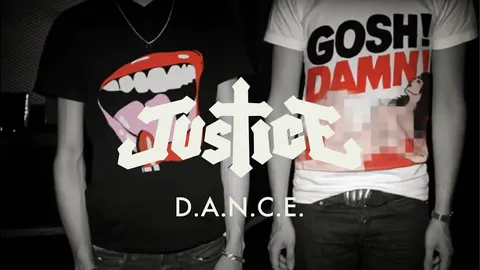
- D.A.N.C.E. A children's choir, a Michael Jackson gesture-list, a near-classical melody over an electro-disco kick. The track that made Justice simultaneously club and pop. Read the analysis →
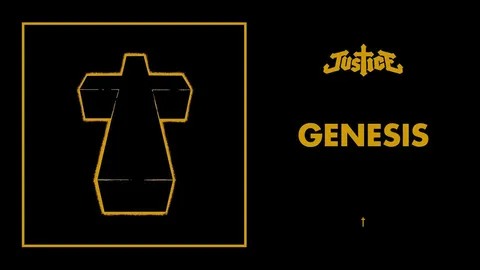
- Genesis 3'54" of electro-classical music without a single voice. The saturated harpsichord that opens the album — sonic manifesto before the first word. Read the analysis →
Baroque-club: 1970s rock-classical citation — same borrowing logic, different corpus. Civilization — oratorio melody over distorted bass.
Position: prog/hard-rock pivot. Mixed reception. Unveiling of sources.
Baroque-club: replaced by soul-funk citation — same method, Philly soul / Minneapolis funk corpus.
Position: disco-funk pivot. Testing the permanences without their obvious markers. Sumptuous.
Baroque-club: Neverender (Connan Mockasin) — atmospheric pads evoking psychedelic chamber music. Another way of citing the academic.
Position: collaborative, cosmic return. Tame Impala, Thundercat, Miguel. Openness without betrayal.