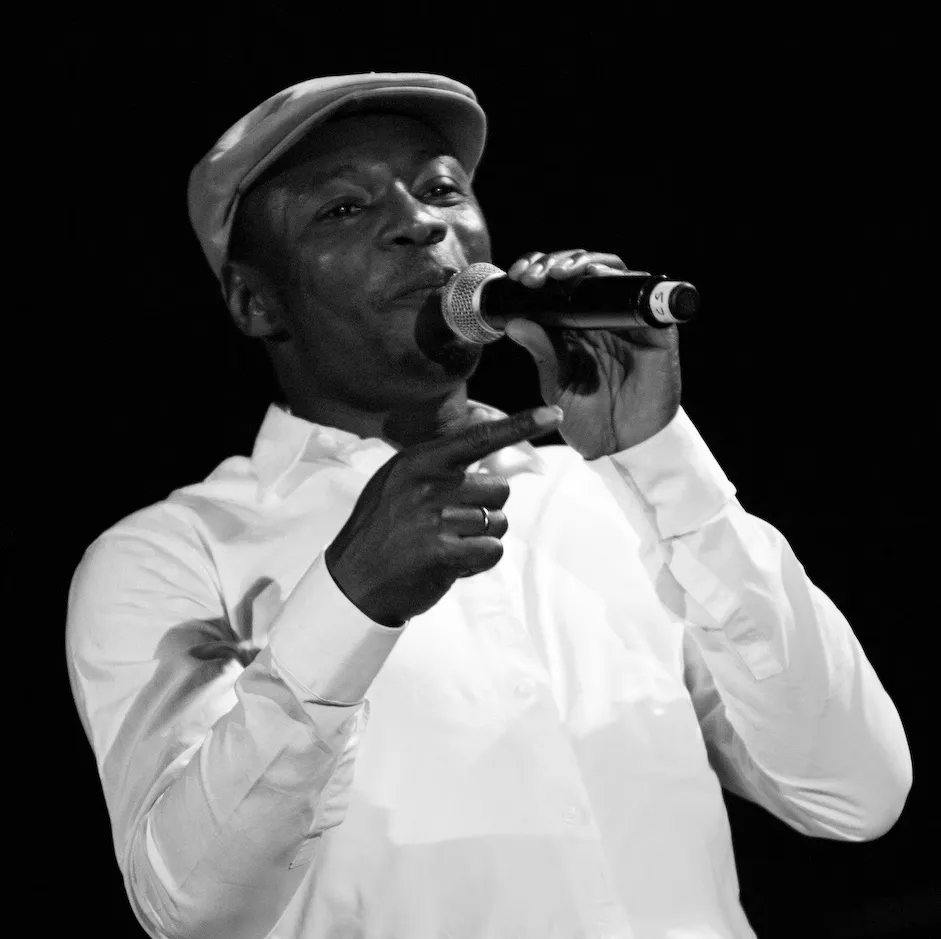
MC Solaar
Paris — French Rap · Sustained Metaphor
Thirty-five years, six pivot albums, a lawsuit won against Polydor, a Victoire de la musique in the chanson française category in 2018. Claude Honoré M'Barali (born in Dakar, son of Chadian parents, raised in Saint-Denis) establishes in 1991 a third path in French rap: language as architecture — the sustained metaphor held from first bar to last, inherited from Brassens, Gainsbourg, Queneau. And rap as courtesy — structural refusal of the shout, the posture, the invective. Thirty-five years of caressing flow that never yields.
Why the word stands in for the fist
In 1991, French rap hesitates between three paths: the Parisian rage of NTM, the Marseille pyramid of IAM, and — the least expected third way — language as architecture. MC Solaar (Claude Honoré M’Barali, born 5 March 1969 in Dakar, son of Chadian parents, raised in Saint-Denis) chooses this third path. Not by default, but by programme. He does not translate American hip-hop — he passes through it, reversing it back toward Brassens, Gainsbourg, Queneau, Boris Vian, San-Antonio. Rap as a literate French genre, not as an import.
Thirty-five years on, Caroline, Bouge de là, Nouveau Western, Victime de la mode, Solaar pleure have entered the school canon. Solaar is taught in French secondary schools as an example of contemporary lyricism. In 2018, he receives the Victoire de la musique in the chanson category — not rap. One category name says everything: official France recognises a chansonnier, direct heir to a tradition that predates hip-hop.
The six pivot albums structuring this cartography trace an arc in four movements: the literate foundation (Qui sème le vent récolte le tempo, 1991; Prose Combat, 1994), the commercial peak and the rupture (Paradisiaque, 1997), the Sentinel Ouest dissidence (Cinquième As, 2001; Chapitre 7, 2007), and the late consecration (Géopoétique, 2017). Between the first album and the last: twenty-six years, two different labels, a lawsuit won against a major, and two permanences intact.
In the cartographies collection, the bridge with IAM is the most solid and most structural. Both formations release their first albums in 1991 — De la planète Mars in March, Qui sème le vent… in October. They represent the two competing models of French rap in the 1990s: collective, pyramidal, Mediterranean Marseille for IAM; solo, literate, classical-French-digested Paris for Solaar. IAM writes as one engraves hieroglyphs for collective eternity; Solaar writes as one folds a sonnet for singular elegance. The diptych is documentary and structural.


◆ Musicological studies
The work’s tracks examined closely — device, structure, procedure, lineage, reading under the permanences.


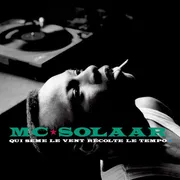
Qui sème le vent récolte le tempo
The literate foundation. MC Solaar invents, in a single album, a French rap that does not translate American hip-hop — it absorbs and reverses it.
Debut album, October 1991. Recorded at Studio Bastille, produced by Jimmy Jay and Boom Bass (Hubert Blanc-Francard, later one half of Cassius), mixed by Philippe Zdar (later the other half of Cassius). The trio that would define MC Solaar’s sonic identity for a decade is already in place: a caressing flow, low voice, sustained metaphor, and literary sampling.
The album appears in the same year as IAM’s De la planète Mars and NTM’s Authentik — 1991 is year zero for the French rap album. Where NTM mines rage and IAM constructs the Marseille pyramid, Solaar chooses a third path: language as architecture. Caroline is built on the card game metaphor. Victime de la mode critiques consumerism through a suave spoken-word. Bouge de là is generally considered the first documented sample in French rap (Cymande, The Message).
Gold record, over 400,000 copies sold. The French intelligentsia recognises something it had been waiting for: Brassens, Gainsbourg, Queneau digested by hip-hop. Solaar does not translate American rap — he passes it through a different literary genealogy.
The apparatus
Jimmy Jay’s production rests on slow beats, soul samples, and rounded basses. Solaar’s voice — poised, articulate, every syllable precise — settles over the loops without overwhelming them. The sample on Bouge de là (Cymande, 1972) is simultaneously a musical citation and a manifesto: French rap has African-British roots, not only American ones. The album title itself is a programme: a biblical proverb twisted through the word tempo.
Une dame de cœur avec le valet de carreau / C’est une histoire banale qui met le feu au château
”A queen of hearts with the jack of diamonds / It is a banal story that sets the castle ablaze”— MC Solaar, Caroline, 1991
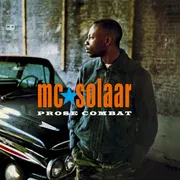
Prose Combat
The critical apex. Sustained metaphor as declared programme, rap as transposed cinematic narrative.
Second album, 9 February 1994. Production team unchanged: Jimmy Jay and Boom Bass, Philippe Zdar on the mix, Tom Coyne mastering. The album is denser, more sustained, more melancholic than the debut. In 1993, Solaar had recorded Le Bien, Le Mal with Guru on Jazzmatazz Vol. 1 — the first international collaboration for a French rapper. That New York validation feeds Prose Combat: Solaar is taken seriously beyond France.
The title is a manifesto. Prose — the French language, literature, the written form. Combat — not violent confrontation, but the text as joust. Citation becomes method: Nouveau Western samples Gainsbourg/Bardot (Bonnie and Clyde) and multiple soul sources (Sly & the Family Stone, Lee Dorsey, Steppenwolf, Betty Wright). Rap becomes a transposed cinematic narrative: the American western lands in Saint-Denis.
Platinum record, one million copies sold, instant classic. Prose Combat installs Solaar in the canon — not only of French rap, but of chanson française in the broader sense. The national press (Les Inrockuptibles, Libération) treats it as a literary event.
The apparatus
Jimmy Jay and Boom Bass tighten their production. The beats are less rounded than on the debut — more sculpted, more melancholic. The Gainsbourg/Bardot loop on Nouveau Western is an unprecedented gesture in French rap: to cite chanson française inside rap not to flatten it but to honour it and carry it forward. Zdar mixes with a precision that keeps every syllable of Solaar at the forefront.
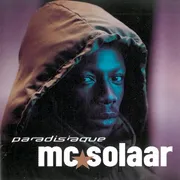
Paradisiaque
The pop apotheosis. The Cassius sound, French funk-rap at its commercial peak, and the legal rupture that follows.
Third album, 17 June 1997. Production: Boom Bass and Philippe Zdar (now Cassius, signed to their own label), DJ Mehdi on one track. The sound broadens: brighter, more funk-rap oriented, with nods toward Los Angeles G-funk (Tournicoti) and New York’s jiggy aesthetic. Solaar samples Teddy Pendergrass and embraces a lightness previously less present in his work. Paradisiaque is the most accessible album in the discography.
Solaar pleure is the pivotal track: for the first time, melancholy installs itself as a central method. It will never again be an incidental detour. Solaar still does not raise his voice — but he weeps, and this is more powerful. Courtesy holds even in grief.
Key legal development: Polydor releases the eponymous album MC Solaar separately in July 1998 against the artist’s wishes. Solaar litigates. The Paris Court of Appeal (2002) and the Cour de cassation (2004) rule in his favour: since the early 2000s, the first four Polydor albums have been forbidden from commercial exploitation in France. A canonical body of work struck by commercial invisibility.
The apparatus
Cassius production brings a funky brightness the first and second albums did not have — the bass is round, the soul samples glitter, the mix is open. Solaar absorbs this without sacrificing his articulation. The paradox of Paradisiaque: the most pop album simultaneously signals the melancholy of Cinquième As. Solaar pleure sits there as a quiet alarm in an otherwise solar record.
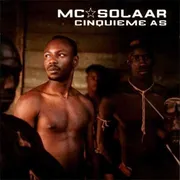
Cinquième As
Rupture and reconquest. Solaar founds Sentinel Ouest, proves he exists without a major label, diamond record in full autonomy.
Fourth pivot album, 20 February 2001. Following the legal battle against Polydor, Solaar founds his own label Sentinel Ouest and signs distribution with East West (Warner Music France). Cinquième As is the first album of this independence — and it is certified diamond. Over one million copies sold. Solaar proves two things at once: he exists without his former label, and he makes that label responsible for the disappearance of his classics.
The tone shifts. Less funk, more spacious, fewer samples, more direct writing. The melancholy that surfaced in Solaar pleure settles in as a method. RMI (« Rythme MC Indéfini ») and Hijo de África open a geopolitical perspective that Géopoétique will systematise sixteen years later.
Hijo de África is a geopolitical manifesto on deportation and African memory — a track that confirms that Solaar’s courtesy is not an absence of substance. The critique is dense and present. But it comes through the text, not through invective. The combative politeness of Prose Combat finds its geopolitical formulation here.
The apparatus
The production shifts: less expansive funk, more textural layers, more space. Sentinel Ouest also means production more directly controlled by Solaar. Texts lengthen, metaphors become more complex. La vie est belle is a simple declaration concealing deep melancholy. The diction remains impeccable, the flow as caressing as ever — but the voice carries more weight.
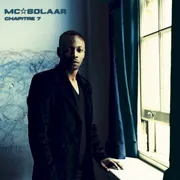
Chapitre 7
The meditative retreat. Writing tightens, tempo slows, maturity overtakes event.
Fifth studio album, 18 June 2007. Seventh release counting the eponymous album and Mach 6 (2003) — hence the title. Six years after Cinquième As, Solaar is forty. Chapitre 7 is the album of meditative retreat: writing tightens, tempo slows, the large pop machines recede. Critics describe it as an album of maturity; part of the wider public has drifted away. French rap has pivoted toward Booba. Solaar maintains his contract with the literate France without seeking to recapture the charts.
Da Vinci Claude is a literate self-portrait — the rapper as Leonardo. The title plays on the homophony of Claude/Claude. Quartier Nord returns to the geography of childhood, to Saint-Denis, to the banlieue as memory. À temps partiel frames love as a precarious contract — a social metaphor wrapped in a gentle song.
A ten-year silence in recorded output follows — the longest eclipse of his career. Chapitre 7 is, without anyone knowing it at the time, the closure of one phase before the great return.
The apparatus
Sentinel Ouest production turns inward. Fewer bright soul samples, more discreet textures. Solaar’s flow remains impeccable but slows further — each word weighs more when there are fewer of them. The album resembles a private notebook set to music: intimate, dense, unspectacular. Courtesy here takes the form of restraint.
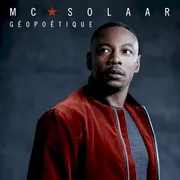
Géopoétique
The late consecration. Ten years of silence, then the 2018 Victoire de la musique — chanson category, not rap.
Sixth pivot album, 3 November 2017. Ten years after Chapitre 7. Production: Alain Etchart, mix by David Gnozzi. The title is itself a declaration of method: geography as poetics, the world as material for inventory. Solaar raps Africa, the Mediterranean, his Chadian family memory, poetry as cartography. Born in Dakar, son of Chadian parents, raised in Saint-Denis — the album closes the biographical loop.
Certified platinum in six weeks. Victoire de la musique 2018 — album of the year in the chanson category — not rap: chanson française. Official France recognises Solaar as a chansonnier in the full sense of the term, direct heir to a Brassens-Brel-Gainsbourg tradition passed through sampling and flow. One category name says it all.
In 2022, Hip Hop Symphonique 6 (Radio France) arranges Caroline and Nouveau Western for orchestra — Solaar in symphonic form. The loop is closed: literate rap has become heritage.
The apparatus
Alain Etchart’s production is broader than the Sentinel Ouest albums: atmospheric pads, African percussion, discreet orchestrations. Sonotone (the lead single) is a plea for bass frequencies — physical sound, sound felt before it is heard. Géopoétique (the title track) systematises the method: each place becomes a metaphor, each geography a poetics. The Mediterranean as syntax. Africa as grammatical root.
A body of work in four movements
Thirty-five years, six pivot albums, a lawsuit won against a major label, a Victoire de la musique in the chanson française category. The MC Solaar trajectory divides into four distinct movements — each testing a different dimension of the foundational double thesis: language as architecture, rap as courtesy.
What never changes
Two permanences traverse the four movements without faltering. Language as architecture — from Caroline (1991) built on the card game to Géopoétique (2017) which systematises the world as a text, through Nouveau Western (the western genre transposed to Saint-Denis) and Hijo de África (diaspora memory as sustained metaphor), Solaar never yields on rhetorical construction. The metaphor is not ornament — it is the load-bearing structure. Rap as courtesy — in thirty-five years and six pivot albums, Solaar has not shouted. Not one direct invective. His critique of consumerism (Victime de la mode), cultural imperialism (Nouveau Western), and the slave trade (Hijo de África): always through metaphor, never through rage. This is not absence of substance — it is an ethics of the text.
The bridge that holds
One solid bridge in the collection: IAM. Structural, documentary, irreducible. Both formations release debut albums in 1991 and represent the two competing models of French rap — collective-pyramidal Marseille for IAM, solo-literate Paris for Solaar. The diptych holds over time: IAM engraves hieroglyphs for the collective, Solaar folds sonnets for singular elegance. Two methods, one shared demand for textual rigour. In the cartographies collection, both cartographies read together or they do not quite read at all.
The map
Six records in orbit around the two permanences. Click an album to see how it declines them.
Courtesy: caressing flow, articulate diction, romantic breakup handled in private. No shout. Politeness as programme from the first album.
Position: literate foundation. 1991, year zero of French rap.
Courtesy: critique of American cultural imperialism without direct invective. Demonstration replaces injunction.
Position: critical apex. Platinum. Instant classic.
Courtesy: assumed lightness as a form of courtesy. Solaar weeps — he does not shout.
Position: pop apotheosis. Legal rupture with Polydor follows.
Courtesy: critique of deportation and imperialism without invective. Dignity as a form of courtesy.
Position: Sentinel Ouest dissidence. Diamond. Proof of existence without a major label.
Courtesy: restraint as the highest form of politeness. No posturing against relative commercial eclipse. He writes.
Position: meditative retreat. Ten years of silence will follow.
Courtesy: wisdom as the final posture. Thirty years without shouting. Victoire de la musique chanson album 2018 — not the rap category.
Position: late consecration. Heritage.