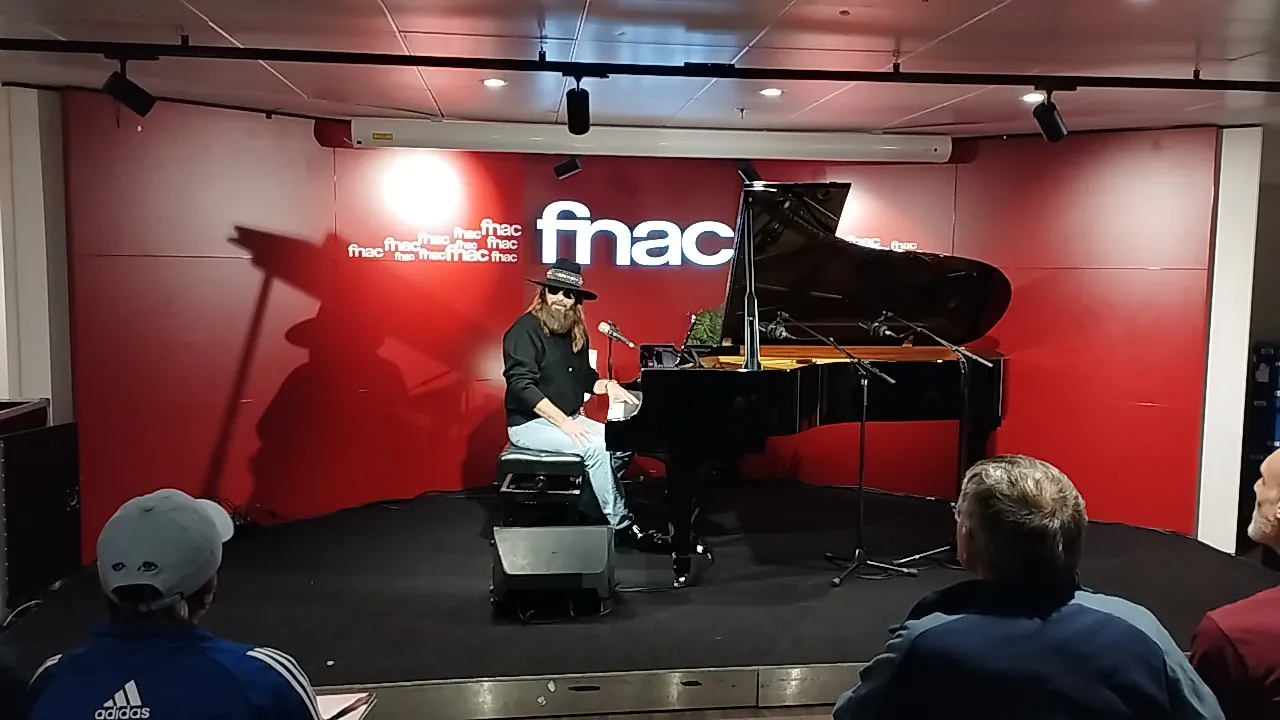
Sébastien Tellier
Paris — Cosmic chamber-pop
Six studio albums, a distant baritone voice, and amorous cosmologies built one album at a time — from the Pavlovian Italy of his debut to the blue cult of 2012, the phonetic Brazil of 2014, and the domestic interior of 2020. Produced by Air, then by Thomas Bangalter, Tellier is the Record Makers artist who pushed furthest the idea that an album can be a genre novel.
Why love is a cosmology
Sébastien Tellier is not a popular singer. Nor is he a cult artist in the usual sense — too present for confidentiality, not present enough for the mass market. He is something rarer: an artist who has built, across six albums over twenty years, a body of work whose coherence only becomes visible when you step back far enough to see it whole.
Born in Paris in 1975, he enters music through the grand entrance — produced by Air on his debut in 2001, signed to Record Makers (the label ecosystem that launched Phoenix, Cassius, Air), with a deep voice and a method already formed. This is not a hesitant starting point. It is an opening statement.
The six albums that follow — from L’Incroyable Vérité (2001) to Domesticated (2020) — show how these two constants traverse radically different sonic universes. The chamber grammar of the beginning, Bangalter’s electro-disco, the conceptual monochromy of My God Is Blue, the tropical acoustics of L’Aventura — each album tests the constants in a new setup. They hold.
Two structural bridges connect Tellier to the collection: Air produced L’Incroyable Vérité in 2001 — biographically and musically, Tellier is a direct extension of the Record Makers ecosystem that Air helped build. And Thomas Bangalter, half of Daft Punk, produced Sexuality in 2008 — the bridge between chamber French Touch and club French Touch, united on a single album.


◆ Musicological studies
The work’s tracks examined closely — device, structure, procedure, lineage, reading under the permanences.



L'Incroyable Vérité
The grand entrance. Air produces, Record Makers welcomes, Tellier arrives.
Sébastien Tellier’s debut album, Paris 2001, age twenty-six. Not a youthful record — an opening statement, produced by Air (Nicolas Godin and Jean-Benoît Dunckel), recorded within the orbit of Record Makers, the label that had just launched Phoenix and would become the ecosystem for all French chamber-pop of the 2000s. Tellier doesn’t arrive by accident: he arrives with a language and a voice already formed.
The sound is immediately recognizable: muted strings, Höfner basses, Mini-Moog, Mellotron pads. Pure Air DNA — but something is different. The voice. Tellier sings in a deep baritone, detached, barely inflected. Not Dunckel’s voice (high, light) nor Godin’s (rarely vocal). A voice that seeks to blend into the arrangement rather than dominate it.
The setup
The album rests on a tension between orchestral density (the strings, omnipresent, envelop every track) and Tellier’s vocal restraint. Melody precedes text — La Ritournelle appears here in its instrumental form, voiceless, as if Tellier had first invented the melody and was still searching for what to do with it. This choice is revealing: in Tellier’s world, the voice always comes second.
"A debut of troubling maturity — Tellier doesn’t imitate Air, he enters into dialogue with them.”— summary of period critical reception
The imaginary Italy
There is in this album a Pavlovian Italianness — an evocation of Fellini’s Italy, of 1960s sentimental comedy, of velvet and sweet melancholy. Not documentary, but fantasized. Tellier builds here for the first time a universe that exists only inside the record. This gesture — the album as a sealed world — will become his method.

Politics
La Ritournelle. Seven minutes. The vocal constant at its purest.
Three years after L’Incroyable Vérité, Tellier returns without Air at the helm — he takes sole control. Politics is his first truly autonomous album, and also the one where he places the track that will cross all decades: La Ritournelle, seven minutes and two seconds, one chord progression, Tony Allen on drums, a voice that floats and holds.
The album is called Politics — an absurd title for a record with nothing political about it. Or rather: Tellier’s political act is his refusal of politics. In 2004, France is post-9/11, Raffarin government, Iraq war. Tellier releases a slow baroque pop album about universal love. The posture is clear and clearly assumed.
The setup
Production has loosened since L’Incroyable Vérité — fewer ornamental strings, more space between instruments. The Höfner bass is still there, drumming light and skeletal, harmonies layered softly. The Beach Boys influence is more visible: Pomme resembles a Pet Sounds track rewritten in French, tempo slowed by half.
"La Ritournelle is one of the most beautiful pieces ever written in France — and one of the least heard at its release.”— summary of retrospective critical reception, NME 2011
The voice at work
It is on Politics that Tellier’s voice finds its full formulation. Deep baritone, little vibrato, slightly nasal, always behind the arrangements in the mix. On La Ritournelle, he sings over a single harmonic progression (four chords turning for seven minutes) — and the magic operates: repetition creates hypnosis, and the voice settles into this space as if it had always been there.

Sexuality
Bangalter produces. Electro-disco takes hold of Tellier — his voice resists.
Four years without an album. Then Sexuality — produced by Thomas Bangalter (Daft Punk). The news is spectacular: a pillar of the club French Touch arrives in Tellier’s chamber-pop universe and transforms it from the ground up. Saturated synthesizers, deep bass, luxuriant production — everything that made L’Incroyable Vérité and Politics discreet is replaced by a frontal, assured, almost aggressive sound.
The same year, Tellier represents France at the Eurovision Song Contest with Divine. He arrives in Belgrade in a golf buggy displaying the French flag, five backing singers who all look like him (same face, same beard, same glasses), and sings mainly in English — triggering a parliamentary debate on the French language. 19th place. The affair generates far more noise than the result.
The setup
Bangalter doesn’t erase Tellier — he amplifies him in an unexpected direction. The deep baritone remains, but it is now framed by saturated Moog synthesizers, dry snare drums, bass that makes subwoofers tremble. Sexual Sportswear oscillates between Giorgio Moroder’s disco and French chamber-pop — a hybridization that didn’t exist before 2008.
"Tellier found in Bangalter not a producer but a developer — someone who makes electronic music sound like chamber music.”— summary of critical reception, Pitchfork / Les Inrockuptibles 2008
Eurovision as manifesto
Divine deserves to be heard as an aesthetic manifesto, not as a contest entry. Tellier constructs a tinsel Californian erotic deity with vocoded Beach Boys harmonies and a production borrowing equally from Vangelis and Moroder. That this object went to Eurovision — and caused scandal — says something about the state of French institutional pop.

My God Is Blue
The blue cult. A concept album built as a hermetic cosmology.
Four years after Sexuality and the Eurovision elevation, Tellier returns with a radically different object: a concept album built around the “Religion Alliance Bleue” — a fictional belief system in which blue is god-color, salvation-color, end-color. This is not ironic. This is not second-degree. Tellier has built a coherent system and sings it with the same seriousness as a theologian.
Commercial success is lower than Sexuality — the album is hermetic, tracks are long, the sonic palette is cold and blue. But My God Is Blue is the most radically coherent album of Tellier’s career: every production choice, every arrangement, every lyric serves the total concept.
The setup
Production is more electronic and cold than Sexuality — less Bangalter warmth, more conceptual rigor. Synthesizers are treated with long pads and suspended chords. Tellier’s voice is sometimes vocoded, sometimes heavily processed, sometimes bare — but always placed in the same uncomfortable zone between singing and recitation.
"My God Is Blue is an album you don’t listen to — you live inside it. Or you don’t understand why you should enter.”— personal synthesis, summary of divided critical reception, 2012
Monochromy as aesthetic decision
Everything is blue. The cover, the visuals, the videos, the press releases. Tellier pushed the album-as-world logic to its extreme: if the universe is blue, everything must be. Cochon Ville is dark and stocky, syncopated rhythm, deep voice — midnight blue. Pépito Bleu is more aerial, light harmonies — sky blue. Color functions as structural device as much as metaphor.
L'Aventura
The phonetic Brazil. An album sung in languages Tellier doesn't speak.
Two years after the blue cult, Tellier departs for Brazil — an imaginary Brazil, phonetic, dreamed from Paris. L’Aventura is sung entirely in approximate Spanish and Portuguese, sometimes phonetic, sometimes invented. Tellier doesn’t speak these languages. It doesn’t matter. What counts is the sound, not the meaning.
For the first time in his discography, a female voice occupies a central place — that of Elena Tellier, his partner, whose mezzo-soprano creates an unexpected duet with Sébastien’s deep baritone. Arrangements are enriched with Brazilian percussion, nylon-string guitar, flutes — all the textures of bossa and samba, filtered through a European chamber-music ear.
The setup
This is Tellier’s most acoustic album since Politics. Synthesizers recede, string instruments return — but warm, tropical strings, not the muted strings of Air. Tempo syncopates, Brazilian percussion (pandeiro, cajón, zabumba) structures the groove. The production is organic, alive, sunlit.
"L’Aventura is the album where Tellier allows himself to be joyful — without losing his seriousness.”— personal reading, listening summary
Language as sonic object
Singing in a language you don’t master is a radical gesture. Tellier isn’t the first (Sufjan Stevens sang in Finnish, Sigur Rós invented “Vonlenska”), but he is among the few to make this assumed incomprehension a creative engine. The Spanish and Portuguese words in L’Aventura are chosen for their sonic texture — open vowels, singing consonants — not their meaning. Language as timbre: an extension of the vocal constant.

Domesticated
The inhabited interior. Domesticity as the final fantasized universe.
Six years without an album. Change of label (Record Makers → Atlantic Records), change of producer (Daniel Mason, British producer), change of subject. Domesticated is about conjugal life, household tasks, the home, gentle routine — the least “rock” subjects imaginable, yet treated by Tellier with the same cosmic seriousness as all previous albums.
Released January 2020 — a few weeks before the first global lockdown. The album about indoor life arrives at the moment the entire world is forced to stay indoors. The coincidence is striking and was not lost on critics.
The setup
Daniel Mason brings a more minimal, stripped production than anything Tellier made with Bangalter. Fewer synthetic pads, more exposed voice, chamber arrangements but sober. Domestic Tasks is an almost folk track — acoustic guitar, close voice, little processing. The first time Tellier allows himself to be heard this directly.
"Domesticated is the album where Tellier stops building universes and simply lives inside one.”— personal reading, listening summary
Domesticity as cosmology
Reading Domesticated as a retreat or a settling-down would be a mistake. Domestic life is for Tellier a universe as constructed as the blue cult or the phonetic Brazil. Washing up, putting a child to bed, being bored together — these ordinary gestures are treated as cosmic rituals, with the same seriousness and the same distance. The home as the final frontier of Tellierian cosmology.
A body of work in four movements
Twenty years of studio output, six records, a silence since 2020. The trajectory breaks into four clear movements — each testing the constants inside a distinct sonic device.
What never changes
Two constants run through all four movements. The grave-ethereal voice as instrumental signature — detached baritone, treated as a timbre, never the frontal emotional engine. The cosmic-amorous as method — each album builds a fantasized universe in which love is treated with seriousness but without heaviness, refusing both ironic second-degree and first-degree romanticism. These two gestures set down in 2001 haven’t shifted a line in twenty years.
Position in the collection
Tellier is the junction point between two lineages in the collection. On the Air side: the same Record Makers ecosystem, the same French chamber grammar, the same voice-as-timbre. On the Daft Punk side: Bangalter’s production of Sexuality brings together for the first time both wings of the French Touch — chamber and club — on a single album. A pivot artist whose work is readable from both directions.
The map
Six records orbiting the two constants. Click an album to see how it plays them out.
Cosmic-amorous: fantasized Pavlovian Italy — love from an imaginary world.
Position: the grand entrance. Air produces, Record Makers welcomes.
Cosmic-amorous: love as universal force, no narrative, almost like a natural phenomenon.
Position: the masterpiece. Tony Allen on drums.
Cosmic-amorous: erotic mythology — the body as temple, Eurovision as manifesto.
Position: the electro pivot. Produced by Thomas Bangalter.
Cosmic-amorous: the Religion Alliance Bleue — a fictional religion whose central dogma is love.
Position: the absolute concept. Total monochromy.
Cosmic-amorous: Brazil as metaphor — warm, solar, fictional Lusophone love.
Position: the tropical journey. Elena Tellier in duet.
Cosmic-amorous: the domestic interior sublimated — household tasks as cosmology.
Position: the inhabited retreat. Atlantic Records. Released before the first lockdown.