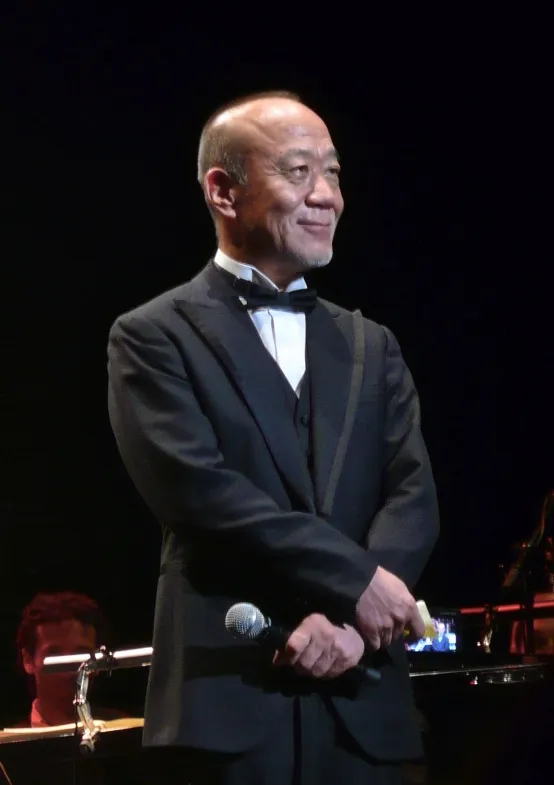
Joe Hisaishi
Tokyo — Film score composition
From Nausicaä of the Valley of the Wind (1984) to The Boy and the Heron (2023), Joe Hisaishi ran two bodies of work in parallel without merging them. Eleven films with Hayao Miyazaki: the grand, memorisable orchestral melody, themes that outlive the image. Seven films with Takeshi Kitano: bare piano, silence, extreme minimalism. Born Mamoru Fujisawa in 1950, trained at the Kunitachi College of Music, he chose his pen name as a phonetic homage to Quincy Jones — Quincy → Kuinshi → Hisaishi. Integral composer, sole author — where Zimmer delegates to Remote Control Productions, Hisaishi writes, orchestrates, conducts. Two permanents run through his entire work: the melody as an autonomous object that outlives the film, and minimalism as formal backbone, inherited from Steve Reich, Philip Glass, Terry Riley.
Why the whistleable melody is a method
Joe Hisaishi asked a single question in 1984 and never stopped asking it: what if the melody comes first? Before the image, before the orchestra, before the harmony — the melody. If it cannot be whistled by a child who has never heard classical music, it cannot work in a Miyazaki film. This is a radical constraint, and it is an explicit aesthetic choice against the textural-atmospheric American film music tradition.
Born Mamoru Fujisawa in 1950 in Nakano, Nagano, trained at the Kunitachi College of Music in Tokyo (composition), he chose his pen name as a phonetic homage to Quincy Jones — Quincy becomes Kuinshi becomes Hisaishi. During his formative years, he studied Steve Reich, Philip Glass, Terry Riley — the composers of American minimalism. Not to imitate them: to extract a method. The repeated pattern. The accumulation of layers. The return to the starting point. This formal backbone will remain his own, even when he composes for a hundred musicians of the Vienna Philharmonic.
The six pivot albums that follow trace the complete arc: Nausicaä (1984) — the method in its original state, synthesisers and nascent themes; Mon voisin Totoro (1988) — the grammar established, Sanpo as a Japanese national standard; Princess Mononoke (1997) — the full orchestral turn, Symphonic Suite and grand orchestra; Hana-bi (1997, Kitano) — the counterpoint, extreme minimalism, silence as material; Le Voyage de Chihiro (2001) — the melodic apex, One Summer’s Day as global standard; Le Garçon et le Héron (2023) — the twilight, the fragments, the cycle closed.
Joe Hisaishi joins in this collection Hans Zimmer and Ryuichi Sakamoto as a film composer whose cartography reveals a method — but his singularity lies in operating as an integral sole author, without a production ecosystem, across two radically different cinematic universes without ever confusing them.


◆ Musicological studies
The work’s tracks examined closely — device, structure, procedure, lineage, reading under the permanences.


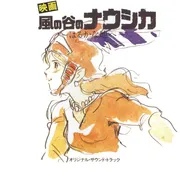
Nausicaä de la vallée du vent
The origin. Synthesisers + light strings. The melodic grammar before the full orchestra.
First Miyazaki score. Joe Hisaishi is 33, coming from an electronic minimalist practice — solo albums Information (1982) and Data Of The Pulse (1984) — when Miyazaki commissions the music for an animated adaptation of his own manga. Budget is limited, production conditions rudimentary compared to contemporary Hollywood scores. Hisaishi composes with what he has: analogue synthesisers, a few live strings, a flute.
The result is hybrid yet already singular. The themes are there, complete, memorisable on first listening. Nausicaä Requiem — three notes, female voice, synthesiser ostinato — establishes in two minutes the tone of the entire Miyazaki collaboration to come: emotion arises from simplicity, not from harmonic complexity. The timbre is still electronic, but the method is already that of the mature composer. The melody comes first.
The device
Hisaishi composes the score working directly with Miyazaki on the storyboard — a practice they will maintain until The Boy and the Heron (2023). This is not the image/sound synchronisation of classical Hollywood scoring: Miyazaki sometimes edits his film to music composed in advance. Music structures the image as much as the reverse. The Nausicaä score is thus simultaneously a film score and a standalone album — the themes function without the film.
“I always compose the melody first. Not the harmony, not the orchestration. The melody alone. If it cannot be whistled, it cannot work in a Miyazaki film.”— Joe Hisaishi, NHK World (2019, paraphrase)
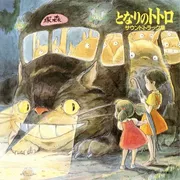
Mon voisin Totoro
Sanpo. Tonari no Totoro. The Miyazaki-Hisaishi grammar established. The landmark album.
Four years after Nausicaä, the second Miyazaki-Hisaishi score marks a break in timbre. Synthesisers are gone: Mon voisin Totoro is recorded with a chamber orchestra — strings, woodwinds, piano, light percussion — and children’s voices. The decision is simple yet decisive: Miyazaki wants music that sounds as if children themselves composed it, simple and direct. Hisaishi chooses the chamber orchestra over the full symphonic orchestra precisely for that reason — each instrument is identifiable, no layer masks another.
Sanpo, the opening theme, is Hisaishi’s best-known piece outside Japanese cinephile circles. Lyrics by Rieko Nakagawa, sung by children — three verses, melody in G major, 2 minutes 16. It has been sung in millions of Japanese schools since 1988, to the point of becoming a national children’s song on a par with traditional folk songs. This is the melody-permanent in its most radical form: the song entirely survives the film.
The device
The Totoro score is the first in which Hisaishi associates a strong melodic theme with each character or place: Totoro has his orchestral theme, the Cat Bus journey has its own, the father has his. This is a classical technique (Wagnerian leitmotif), but Hisaishi simplifies it to the extreme — each leitmotif is a 4-to-8-bar motif, whistleable, never harmonically developed. The musical identity card of each element of the film is a melody, not an atmosphere.
“Totoro changed everything. Before, I was afraid of simplicity — I thought people wouldn’t take it seriously. Totoro taught me that simplicity is the hardest form to achieve.”— Joe Hisaishi, Variety (2023, paraphrase)

Princess Mononoke
The orchestral turn. Symphonic Suite. Hisaishi as fully-fledged classical composer.
Thirteen years after Nausicaä, the Princess Mononoke score (1997) marks a radical transformation of the device. Miyazaki is making his most ambitious film — a medieval Japanese epic interweaving shinto animism, conflict between nature and industry, explicit violence — and asks Hisaishi for music to match. For the first time, Hisaishi composes for a full symphonic orchestra, recorded with the Tokyo City Philharmonic Orchestra. The result is no longer a Japanese animated film score: it is a symphonic suite in its own right.
The Symphonic Suite of Princess Mononoke — commissioned and recorded the same year, separately from the film score — is the piece that establishes Hisaishi as a recognised classical composer beyond the Ghibli context. The Legend of Ashitaka: low strings in ostinato, brass in successive entries, crescendo over four minutes, no identifiable main melody in the first minutes — the score reaches emotion through orchestral accumulation, not through whistleable melody. The minimalism permanent at symphonic scale.
The device
The vocal theme Mononoke Hime (sung by Yoshikazu Mera, counter-tenor) is the melodic exception of the album: a long, Japanese-ornamented melody, accompanied by koto and strings. It creates a deliberate contrast with the rest of the score — the action pieces are orchestral-minimalist, the main theme is melodic-vocal-traditional. Hisaishi plays both permanents within a single album.
“For Mononoke, I wanted the music to be as ancient as possible. Not ancient in a decorative way — ancient in its structure, in the way it moves.”— Joe Hisaishi, liner notes Princess Mononoke Symphonic Suite (1997)
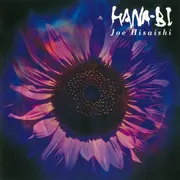
Hana-bi
Kitano. Piano + strings. Minimalism in its purest state — the exact counterpoint of Mononoke.
1997: same year as Princess Mononoke, the Hana-bi score appears in a completely different universe. Takeshi Kitano makes a film in black and colours — paintings Kitano himself created for the film, intercut between scenes. A retired policeman. His dying wife. Yakuza. Violence treated as punctuation, not dramaturgy. Kitano asks Hisaishi for music that does not comment, does not underline — that exists alongside the film, as the paintings do.
The decision is radical: solo piano + pizzicato strings. No orchestra, no brass, no electronic synthesis. Pieces last between 30 seconds and two minutes. They do not develop: they state a motif, repeat it two or three times, stop. The influence of Arvo Pärt (the tintinnabuli style — single bell, lightly trembling strings) is audible. So is Satie (Gymnopédies). This is the minimalism permanent in its most stripped-down expression.
The device
Hana-bi won the Venice Golden Lion in 1997 — the same year Princess Mononoke dominated the Japanese box office. Both Hisaishi collaborations reach their peak simultaneously. This doubling is not accidental: Hisaishi chose never to let one ecosystem contaminate the other. The memorisable melody stays with Miyazaki. Silence and the sound cell stay with Kitano.
“Kitano doesn’t like music that explains. He likes music that exists. He told me: ‘Compose as if the film didn’t exist.’ That is the most difficult and most liberating thing anyone has ever said to me.”— Joe Hisaishi, NHK World (2019, paraphrase)

Le Voyage de Chihiro
One Summer's Day. The melodic apex. Oscar 2003. The score that travels the world.
Spirited Away is the highest-grossing film in Japanese history at the time of its release (2001). It wins the Golden Bear at Berlin (2002), then the Oscar for Best Animated Feature (2003) — the first non-English-language film to receive that award. Hisaishi’s score follows the film on this international trajectory: One Summer’s Day becomes a global piano standard, performed in conservatories across Asia, Europe, and South America.
One Summer’s Day (Itsumo Nando Demo, original song by Wakako Kaku set to music by Hisaishi) is heard three times in the film — first as solo piano under the opening sequence, then in the version sung by Youmi Kimura over the end credits. The solo piano version is the one that has circulated: 2 minutes 19, A major, binary structure A + B, bare piano with no accompaniment. The melody-permanent at its zero degree of arrangement.
The device
The Spirited Away score is the most varied of the entire Miyazaki collaboration: it ranges from light polka (Ride on a Bō) to Japanese fairground music (Sen to Haku’s Theme), through dramatic orchestral score (The Dragon Boy) and One Summer’s Day in its absolute plainness. Hisaishi does not impose a single style — he follows each sequence. But the melody-permanent holds everything together: each piece has a whistleable main theme, even the shortest.
“One Summer’s Day was composed to be a song Chihiro vaguely remembers — something she heard in childhood but can’t quite retrieve. I wanted the melody to feel like an incomplete memory.”— Joe Hisaishi, Animage (2001, paraphrase)

Le Garçon et le Héron
The last Miyazaki. Twilight score. More silences, more fragmented melody.
Thirty-nine years after Nausicaä, the eleventh Miyazaki-Hisaishi collaboration. Miyazaki is 82, Hisaishi 72. The Boy and the Heron (Kimitachi wa Dou Ikiru ka — “How Do You Live?” in Japanese) is presented with no trailer, no press campaign, in total secrecy. It wins the Oscar for Best Animated Feature 2024 and the Golden Globe. For Hisaishi, it is an occasion for taking stock.
The score is the most fragmented of the entire collaboration. Themes are shorter, silences more numerous, orchestration more reduced than in the predecessors. As if Hisaishi was composing with greater economy, aware that each note counts more when fewer are used. The melody is still there — Ask Me Why, the closing song, is memorisable — but it arrives later, with more restraint. Twilight has its own grammar.
The device
Hisaishi composed the score by reading Genzaburo Yoshino’s novel (How Do You Live?, 1937) that Miyazaki gave as the sole key to the film. Working from text rather than images is unusual in their collaboration — Miyazaki had no complete storyboard at the time of the musical commission. The result is a score that searches rather than asserts — motifs that settle, lift, return. Maturity as method.
“This film is a testament. I don’t know if it’s the last — Miyazaki always says he’s working on the next one. But The Boy and the Heron sounds like a conclusion, and I composed the music hearing it as such.”— Joe Hisaishi, Variety Awards Circuit (2023, paraphrase)
What never changes
Movement I — Electronics and awakening (1981–1987)
Before Miyazaki, Hisaishi composes solo minimalist electronic albums — Information (1982), Wasuremono (1983), Data Of The Pulse (1984). The encounter with Miyazaki for Nausicaä (1984) is first and foremost a meeting of methods: Miyazaki composes in images, Hisaishi in melodies. Together they decide the music will come before the final edit — that the melody will precede the image. This founding decision will never be questioned.
The Nausicaä score is still hybrid — synthesisers + light strings — but the themes are already there, complete and whistleable. Kiki’s Delivery Service (1989) consolidates the method. The Miyazaki-Hisaishi grammar is established.
Movement II — The established grammar (1988–1996)
My Neighbor Totoro (1988) is the pivot moment: the chamber orchestra replaces the synthesisers, Sanpo becomes a national song, the melodic grammar is instituted. In parallel, Hisaishi begins the Kitano collaboration with A Scene at the Sea (1991) and establishes the second idiom — silence and the short sound cell.
The two ecosystems coexist without contamination. Only Yesterday (1991), Porco Rosso (1992), Pom Poko (1994), Whisper of the Heart (1995) — the Miyazaki output is dense, Hisaishi composing for a coherent universe. Sonatine (1993) — Kitano — is the opposite: radical minimalism, piano alone, yakuza waiting for death while playing on a beach.
Movement III — Double summit (1997–2001)
1997: the same year sees the release of Princess Mononoke (full symphonic orchestra, Symphonic Suite, major blockbuster) and Hana-bi (piano + strings, Golden Lion at Venice, absolute minimalism). The two pillars of the body of work at their purest, simultaneously. Hisaishi stands at both extremes of his own spectrum.
2001: Spirited Away and One Summer’s Day. The 2003 Oscar. International recognition. One Summer’s Day begins to circulate in conservatories around the world — the pivot piece that alone summarises both permanents: autonomous melody (solo piano, whistleable, without the film) and minimalism (binary structure, no development).
Movement IV — The lucid twilight (2004–2023)
Howl’s Moving Castle (2004), Ponyo (2008), The Wind Rises (2013): the Miyazaki returns are more spaced out, the scores more settled. Hisaishi multiplies autonomous orchestral projects — concerts, symphonic albums, Joe Hisaishi in Vienna (2023) with the Wiener Symphoniker. The minimalism permanent now expresses itself in large orchestral form: accumulation, pattern, return, but at the scale of a symphony.
The Boy and the Heron (2023): the last Miyazaki. The most fragmented score, the most present silences. Hisaishi composes with the economy of one who knows each note counts. The cycle closes with the same method that opened it — melody first, minimalism always — but with forty years of maturity.
What never changes
Two permanents, thirty-nine years, eleven Miyazaki films, seven Kitano films, dozens of orchestral albums. The whistleable melody as a scoring method — opposed to textural atmosphere, harmonic architecture, the team approach. Minimalism as the formal backbone — pattern, accumulation, return, even in the large symphonic form.
These two permanents are not opposed: they are the two faces of the same conception. The whistleable melody is possible because it rests on a minimalist structure — short motif, repetition, no development that dilutes impact. And minimalism does not become film music in the absence of melody — it is the melody that gives it its emotional hook. The two permanents support each other.
Bridge — Hisaishi and the collection
In this collection, Hans Zimmer represents the other great school of film music — the orchestra-as-material, the ostinato as architecture, the team approach of Remote Control Productions. The Zimmer/Hisaishi diptych traces two opposing methods that have dominated film music from 1984 to 2024: the West (textural, studio, delegation) and the East (melodic, integral author, minimalism). Ryuichi Sakamoto — also present in the collection — is the third pole: same Japanese generation (born 1952), classical-electronic training, major film score body of work (Merry Christmas Mr. Lawrence, The Last Emperor), but an experimental rather than minimalist-melodic approach. Three composers, three methods, one common period.
The map
Six scores orbiting the two permanents. Click an album to see how it declines them.
Minimalism: repetitive cellular structure inherited from Reich/Glass studies at Kunitachi.
Position: founding matrix. The Hisaishi method is fully formed by 1984 — the melody precedes the image.
Minimalism: chamber orchestra replacing the synthesisers — the melodic grammar is instituted.
Position: pivot moment. The Miyazaki-Hisaishi grammar is consolidated.
Minimalism: low string ostinato + brass accumulation — the Reich/Glass schema at the scale of a 100-musician symphonic orchestra.
Position: orchestral turn. Autonomous Symphonic Suite. Hisaishi as recognised classical composer.
Minimalism: 45-second sound cells, piano alone, silence between pieces. Minimalism pushed to its extreme opposite — no accumulation, just the bare cell.
Position: Golden Lion at Venice. The Kitano counterpoint. Same year as Mononoke — two extremes of the Hisaishi spectrum.
Minimalism: binary structure A + B + A, 8 bars per section, no development. The fundamental minimalist form.
Position: 2003 Oscar. International recognition. The benchmark piece of the Hisaishi method.
Minimalism: orchestral accumulation in large symphonic form — pattern, return, but with forty years of maturity.
Position: the last Miyazaki. The cycle closes with the same method that opened it — melody first, minimalism always.